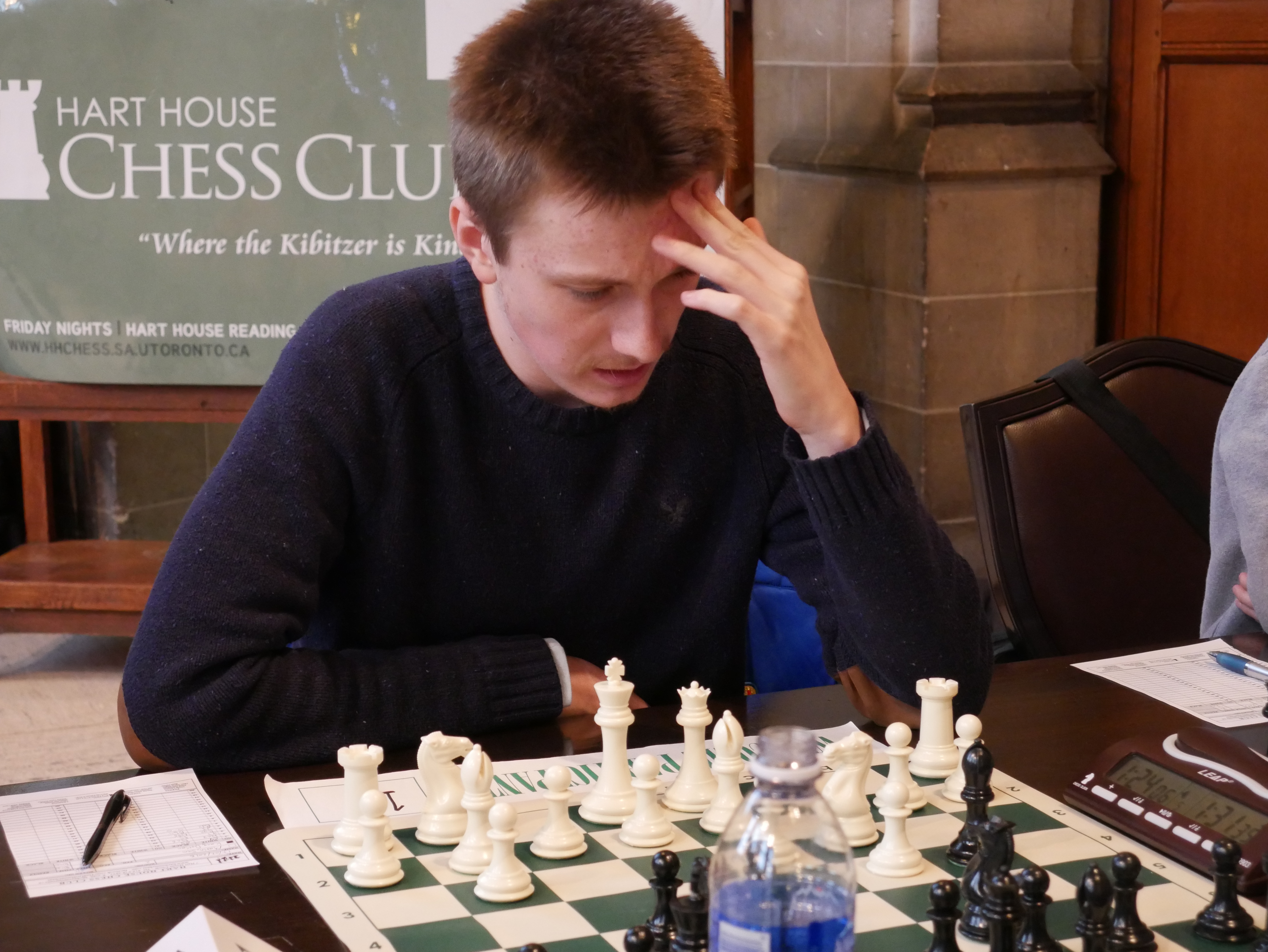
We first met him at the Hart House Reading Room, during our club’s open chess play, when he walked through the main door and challenged one of the strongest players in of our team, Chris Knox! His name is Rhys Rustad-Elliott and he is the creator of a chess engine called “Shallow Blue”. He is also a second-year UofT student, don his major in Computer Science.
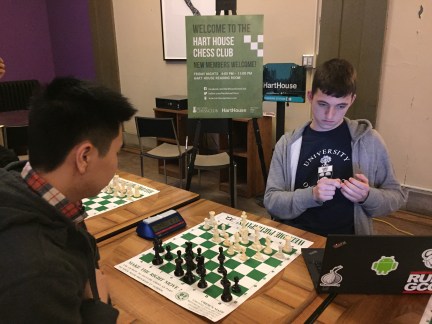
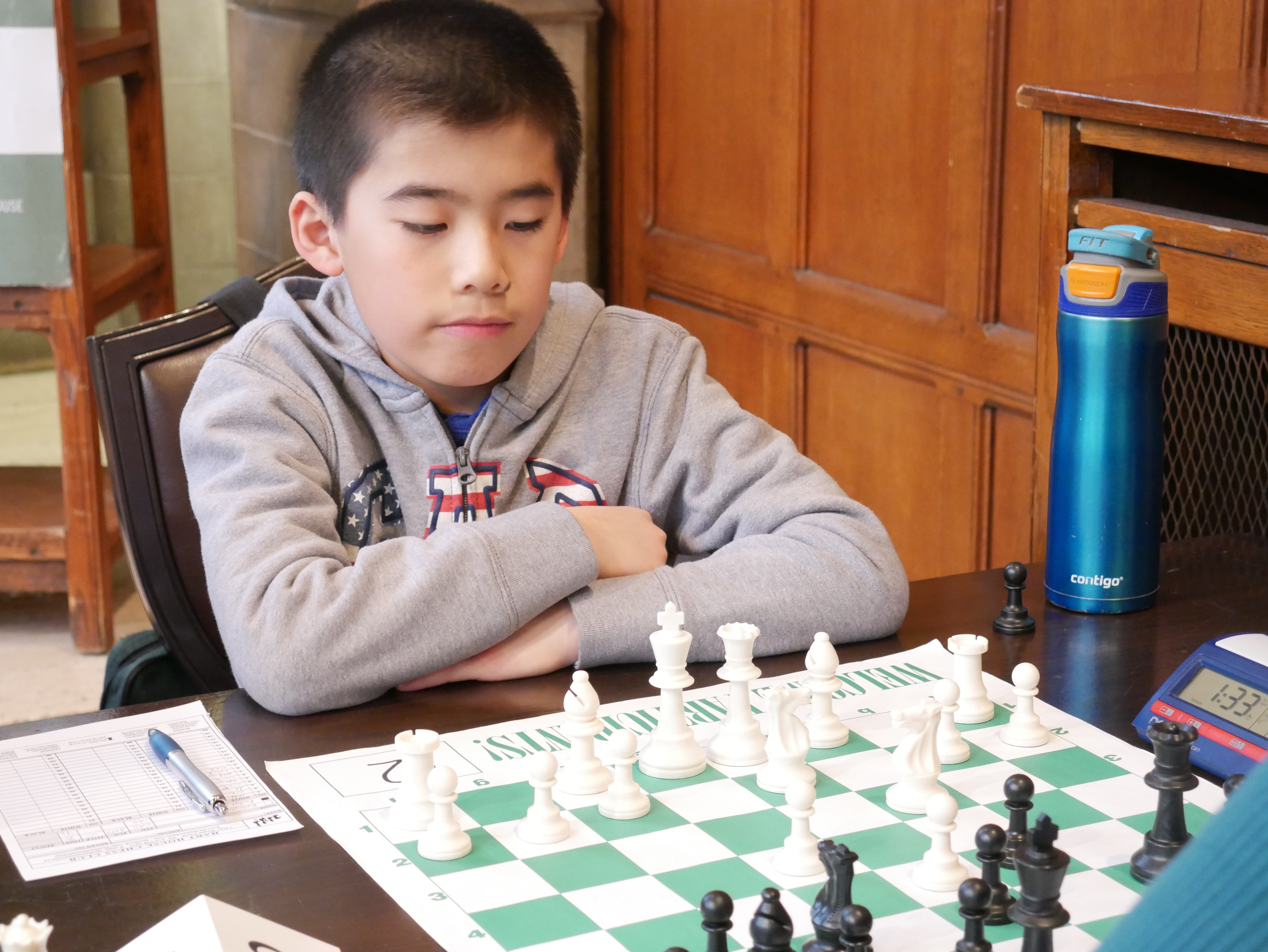
Chris’s chess skills proved too much for “Shallow Blue” but Rhys did not give up. He worked hard to improve the ability of his little beastie and, two months later, here he comes again for another challenge, this time against Andy Liao, one of our club’s execs. After an exciting rapid battle in a Slav-defense, Andy’s position started getting worse and, around move 50, our club’s fundraiser threw in the towel. It was now Panayoti Tsialas’s turn to sit down and play “Shallow Blue”. The engine conducted the opening very accurately but its middle-game strategy was not as good, resulting in a long term disadvantage, which Panayoti duly converted into a full point.
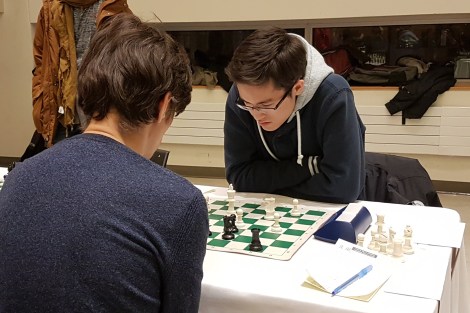
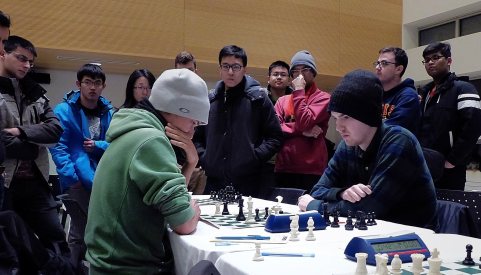
Our own Andy Liao (Black) facing Shallow Blue (White)
It was after we witnessed “Shallow Blue’s” terrific progress that we decided to invite its intelligent and very engaging creator for a lecture at Hart House Chess Club.
But what would the topic be?
Well. Our creative idea was to first watch a documentary on AI, humans and board games and then ask our guest lecturer to reflect on the subject of the film and provide his unique insights as creator of a brute force engine! And what better movies could we have found than the 2017 documentary “AlphaGo”!
Directed by Greg Kohs with an original score by Academy Award nominee, Hauschka, “AlphaGo” chronicles a journey from the halls of Oxford, through the backstreets of Bordeaux, past the coding terminals of Google DeepMind in London, and ultimately, to a seven-day challenge match in Seoul between “Alpha Go” and Lee Sedol!
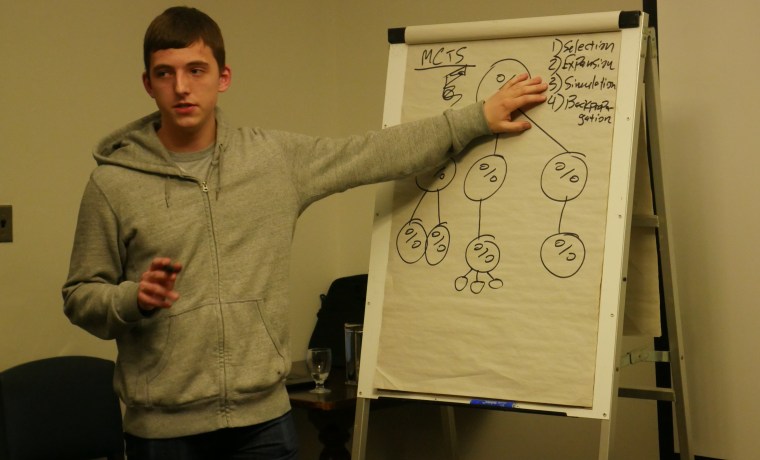
After the movie, Rhys Rustad-Elliott, gave us a thrilling lecture on Computers, Chess and AI! Should the evolution of AI make us nervous? How do you teach a brute force engine how to play chess and beat a Grandmaster? Are engines capable of generating original ideas? Those were only some of the interesting questions addressed by Rhys!
Rhys, who is originally from Vancouver, had an interest in Computer Science and Software Engineering since elementary school, when he started toying around with simple programs in Python. Nowadays, he’s interested in a wide variety of Computer Science related topics and recently finished work on his chess engine, Shallow Blue (a play on words of Deep Blue).
It was a privilege to have hosted Rhys for an elite lecture and an even greater honor to have interviewed him after his lecture!
Earlier this month Hart House Chess Club continued its long-held tradition of representing the University of Toronto at the annual Canadian University Chess Championship. This year’s tournament, which was held at the University of Ottawa on January 13-14, featured five Hart House teams which courageously battled against schools from across Canada in an attempt to win the prestigious title of Canadian Champion for a third consecutive year.
CUCC 2018: A Memoir
The competition was challenging even for the club’s most experienced players. Jimmy Bartha, the Chess Club’s treasurer, offers a brief summary of the year’s most exciting weekend of chess:
“The members of Hart House Chess Club who travelled to Ottawa for the weekend displayed a tremendous amount of sportsmanship and performed exceptionally well. Our A team consisting of Christopher Knox (President), Mark Plotkin, Jim Zhao, and Zehn Nasir finished tied for second place with long-time rivals McGill. They narrowly missed a chance to defeat the eventual first place finishers from Waterloo. In the Reserves section, our C and D teams finished tied for fourth place. While we were unable to defend our title as Canadian Champions, our team is determined and already making plans to reclaim the throne at next year’s championship in Hamilton!”
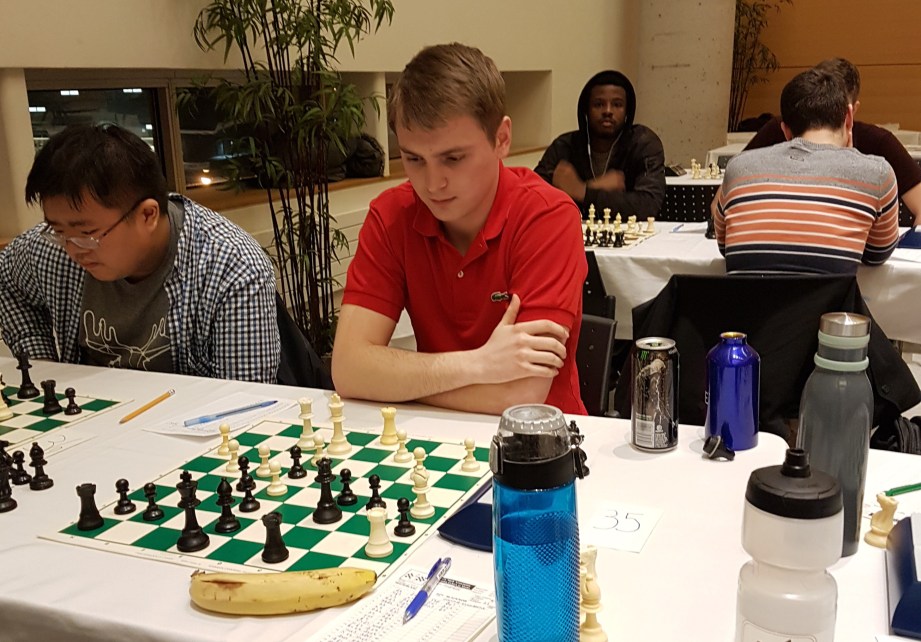
Jimmy Bartha played Board 3 on Univ. of Toronto “C”
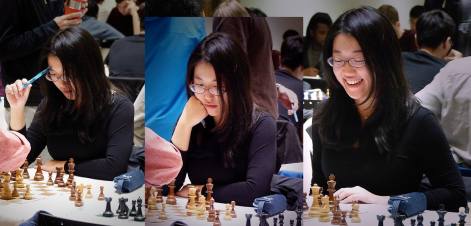
The Chess Club executive this year has placed a strong emphasis on expanding its membership and encouraging participation by both new and experienced players alike. For Alexandra Yao, this year’s championship was an opportunity to showcase and improve her chess while enjoying the camaraderie displayed amongst our players and visiting some of the sites our national capital has to offer.
“In order to visit Parliament Hill and roam downtown Ottawa the day before the tournament, I took the earlier bus apart from my UofT teammates. To my surprise, on that very bus I met teams from other universities who were also participating in the CUCC, and the long road trip quickly flew by as we developed a friendship over our love of the game.
Despite the snowstorm on Friday evening, 30 participants made it to the blitz tournament. We relaxed and got to know one another over a few games of bughouse before diving into 10 rounds of 5.0 blitz.
CUCC provides a chance for competition but also for social interaction and team bonding!
During the tournament proper, I was surprised to find each of my opponents happy to analyze our games afterwards. They patiently demonstrated key moments of the game with me and we discussed stronger lines that could have played. I had analyzed games with my own teammates before, but I had not expected the same practice from unfamiliar opponents, especially after spending hours trying to trap and attack each others’ pieces across the board. Instead, my opponents were encouraging and insightful, and I was struck by their sportsmanship. I learned that many of the higher rated players knew one another well, and had grown up attending the same weekly chess tournaments together.
UofT boasted the most attending players, with a total of 5 teams. Teams played side-by-side and we wished each other good luck, occasionally glancing over at one another’s boards mid-game to take note and analyze afterwards. Eating and laughing together in the lounge, we enjoyed great camaraderie. At the end of the day, chess is a game of war, and it was assuring to have my teammates by my side both in battle and in post-game analysis.
Alexandra Yao: “For the entire weekend, we did nothing but live and breathe chess!”
When players weren’t competing, we were analyzing, spectating, watching GM 1.0 blitz live streams, and even joking about wild chess openings. For the entire weekend, we did nothing but live and breathe chess. It was an honor to represent UofT at the CUCC and a truly unforgettable experience.”
The Competition
The Canadian University Chess Championship is traditionally split into two Divisions: the Competitive Section (Group A) and the Reserves Section (Group B). University of Toronto registered two teams in Group A and three teams in Group B! Team “A”, which was led by National Master and Hart House Chess Club Secretary/President, Chris Knox, finished the tournament undefeated, tying for second place!
National Master, Chris Knox, led U of T’s Team “A”
The competition on Group A was really fierce and Team “A”, seeded #2 in the starting list, was paired against all the favorites (Teams #1, #3, #4, #5 and #6), drawing its matches against #1, #3 and #6 and winning against #4 and #5.
The critical match took place on Round 3, when UofT “A” was facing Waterloo “A”, the tournament’s top seed. Things started out pretty well for U of T, with Chris Knox defeating IM Michael Song on board 1 and Jim Zhao and Zehn Nasir drawing their games on boards 3 and 4 against Diwen Si and Toni Lin respectively. A draw on board 2, in the game of Mark Plotkin against Zi Yi Quin would have been enough for U of T to clinch the match! Mark had the better chances and so he decided to play for the full point but a couple of inaccuracies allowed his opponent to escape and to even seize the initiative, scoring a decisive victory and drawing the match for his team.
“Oopsie!” Mark Plotkin realizes he should have picked the other plan
Three teams, Waterloo “A”, UofT “A” and McGill “A” entered the last round with 3 points. Waterloo defeated U of Ottawa pretty convincingly, whereas UofT was paired against McGill. The match between the two old rivals ended in a draw cancelling both teams chances for winning the precious trophy. As a result, Waterloo finished clear first, dethroning UofT and becoming the new 2018 Canadian University Chess Champion!
“Nasty little thieves, they stole our precious”
For University of Toronto “B”, participation in the Competitive League would have seemed like an uphill struggle as the team was the bottom seed in the competition. However, the four players on Team A really rose to the challenge, scoring 1.5 points in 5 games, climbing one rank up their starting rank and overtaking Waterloo “B” in the final standings (not against our Team “B” too Waterloo 🙂 )!
UofT “B” had a challenging tournament but the players rose to the occasion
2018 Canadian University Chess Championship – Group A / Final Team Standings
1. University of Waterloo A (2400) – 4.0pt
2-3. University of Toronto A (2292) – 3.5pt
2-3. McGill University A (2201) – 3.5pt
4. Queens University (1943) – 3pt
5-6. University of Ottawa (2242) – 2.5pt
5-6. Carleton University A (2122) – 2.5pt
7. University of Western Ontario A (2097) – 2pt
8-9. McGill University B (1928) – 1.5pt
8-9. University of Toronto B (1811) – 1.5pt
10. University of Waterloo B (1881) – 1pt
University of Toronto A: “We’ll be back and we’ll beat Wat!”
In the Reserves Section the competition between the 18 contestants, representing 10 Universities, was also quite strong! With 5 wins in 5 games, University of Western Ontario C (1596) was the sole and uncontested winner of the League! Interestingly enough, the champions did not get to face McGill C (1495), the runner-up team, which scored 4 out of 5 without suffering any defeats.
UofT “C” started-out with 2.5/3 but in the last two rounds the advance of the UofTears was painfully repelled…
In the same division, UofT’s Teams “C” (1490) and “D” (1258) scored 3 points in 5 games and tied for places 3-7. Based on the tournament tie-breaking criteria, Team “C” was 4th and Team “D” placed 7th.
Three points out of five games and a tie for 3rd place in Group B! A remarkable success for UofT “D”!
Finally, U of T’s Team “E” (843) made an amazing effort and played some tough games against more experienced opponents, gaining substantial experience for the future!
Leah Yapp and Asmir Abihi – First time playing in a big chess tournament!
Unfortunately, Team “E” had to start each round with a handicap, playing with only 3 players, that is with an empty board, as Team A’s Loyd Mai (2353), did not make it to Ottawa, resulting in a change in the line-ups of all the teams and leaving Team “E” with one player short. Still, the team scored one point, tying for places 17th-18th but beating University of Ottawa “D” in the tiebreakers, as UofT players had scored more individual victories!
Playing with an empty board did not prevent Team “E”‘s players from enjoying the tournament!
Setting a new CUCC Record
This years’ CUCC was hosted by the University of Ottawa. Chief Organizer of this very successful tournament was the incredible Vice President of Ottawa Chess Club, Zach Dukic, who also played on Board 3 for U of Ottawa’s Team “A”.
Lots of extra work and distraction for Tournament Organizer, Zach Dukic, yet he still came within one move of beating Waterloo Board 2 Joey Qin in the last round!
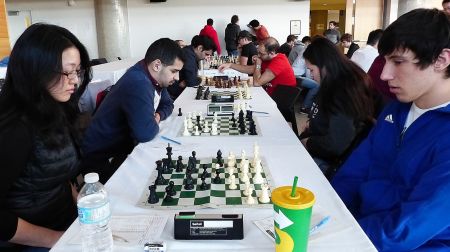
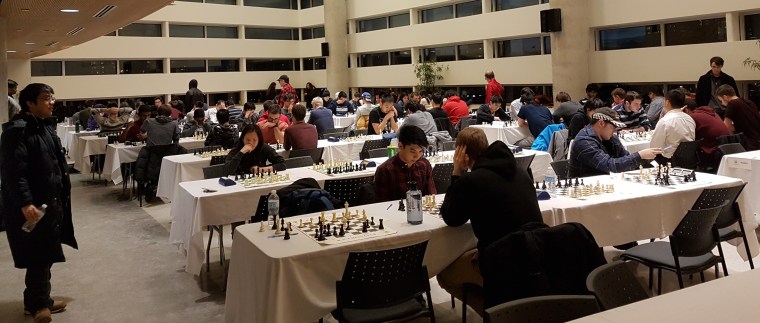
The tournament was held in the hospitable and fairly spacious Desmarais building. According to Dukic, with a total number of 114 participants, this year’s event “set a record for the largest participation in CUCC history!” Indeed, the playing hall was packed with dozens of players, proudly representing their respective Universities! As previously mentioned, U of T was the top chess-player sponsor, by sending out the greatest number of teams and the biggest delegation of players!
The Desmarais Hall proved very accommodating
Out of the 114 players, who signed up for the CUCC 2018, 30 brave ones made the treacherous journey through the snowstorm to participate in a 5.0, 10-round blitz tournament on Friday night (Jan. 12th)! The 150 dollar prize fund, which was generously provided by an anonymous donor, was split 3 ways due to a 3-way tie for first between Tony Bao, Terry Song, and Maroun Tomb, each of whom scored 7.5 points in 10 games.
2018 CUCC Blitz Tourney / Final Standings
Of course, this success wouldn’t have been possible without the hard work and passion of a team of dedicated organizers and volunteers. The RA and Hull Chess Clubs, generously lent chess sets and clocks so that this event could be a success. The very organized and responsible Halldor Palsson, served us the Tournament Director, making sure that everything would go according to plan. John Upper, was present at the event on both days to take many pictures of the playing hall and the players so that the amazing action that took place in the playing could be communicated beyond the four walls of the Desmarais building. Finally, a triad of co-organizers, Misha Voloaca and Sebastian Tansil helped Dukic make the website, reserve the venue and prepare lunch on Saturday.
“You guys did it – you set a record for the largest participation in CUCC history at 114 players”
Next year, the CUCC will be hosted in Hamilton by McMaster University! In his closing statement, Dukic wished good luck to next year’s organizers and thanked all his colleagues – and especially the participants – for the success of the 2018 CUCC. “It warms my heart to see that even as we grow into adults, peer off into separate directions and pursue careers, there will always be a time where we can put our personal lives on hold and meet back at square one, the starting point where we first crossed paths. The chess community among universities is clearly alive and well, and I speak on behalf of the University of Ottawa when I say we can’t wait to see you all next year at McMaster. Until then, I wish you all the best of luck in your future endeavors.”
The 2017 Pan-American Intercollegiate Team Chess Championships (Pan-Am) was held in Columbus, Ohio December 27-30. It was the 64th time this tournament was being held and someone said this would make the event memorable, for 64 are the squares of the chess board!
“The Pan-American Intercollegiate Team Chess Championships (Pan-Am) is open to chess teams from post-secondary schools in North America, Central America, South America, and the Caribbean”, says WIM Alexey Root, former US Women’s Champion and Senior Lecturer at UT Dallas. “At the end of six rounds, four of the U.S. schools qualify for the President’s Cup, to be held March 30th to April 1, 2018. If two teams from the same school (college or university) finish in the top four, then another school high in the standings qualifies. Therefore, some contenders enter multiple teams to increase their chances for the President’s Cup.”
The 2017 PanAm was held at Hyatt Regency in Columbus, Ohio!
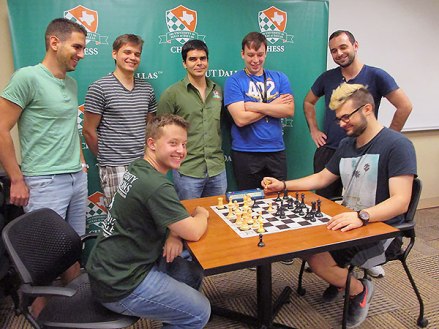
Indeed, to give just two examples, four teams from Webster University and five teams from the University of Texas at Dallas flew to Columbus this year. Each Pan-Am team has four players (called “four boards”) and may have up to two alternates.
The Tournament
Hosted by Ohio State University and the amazing Kelly Bloomfield – organizer, tournament director, DGT broadcaster and advisor – this year’s event was a very competitive one as it hosted 58 teams (but not as many schools since some universities fielded multiple squads), featuring 28 Grand Masters and 16 International Masters! Everything from Ivy League schools to community colleges participated. They came from as far north as Alaska Pacific University in Anchorage to as far south as the National Technical University of Mexico, based in the capital. As always, University of Toronto was represented by two teams and eight players, with Hart House Chess Club’s Coach and Director of Communications, Panayoti Tsialas, as captain of the delegation.
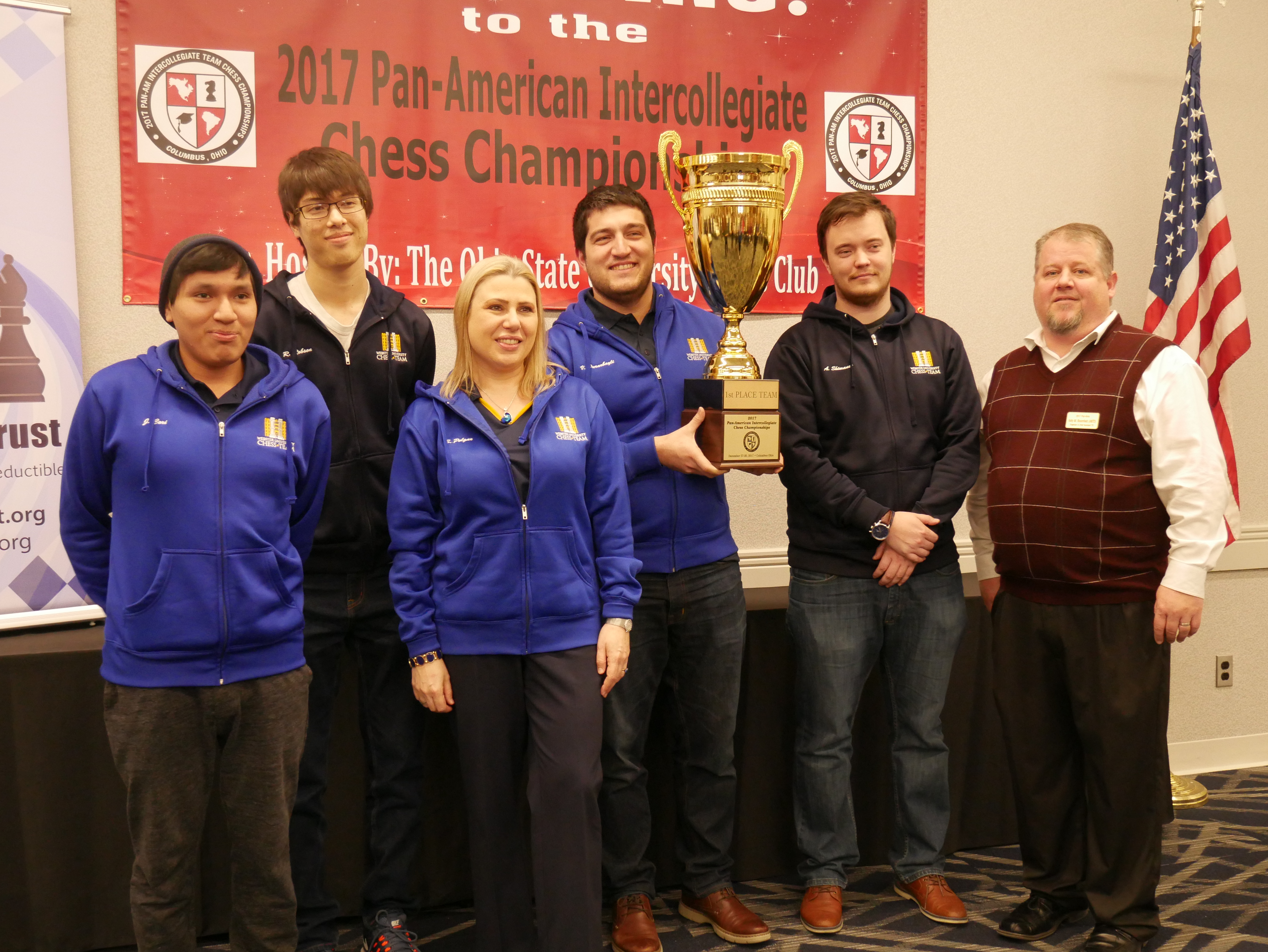
After six exciting rounds, Webster University’s Team A became the clear winner of the 2017 Pan-American Intercollegiate Team Chess Championships (Pan-Am)! For the past five years, the dawning new year has brought Webster at least a share of first place at the end of the premier open college team tournament. This year, their top team made it six, a remarkable streak which eclipses the previous record of five in a row, set from 1998-2002 by the University of Maryland, Baltimore County. However, UMBC and the University of Texas at Dallas are still tied for most all-time wins (10 apiece) but Webster is now six-for-six since their inception in 2012.
Nine GMs, 11 titles: Webster’s top two teams and coach GM Susan Polgar gather in front of their six Pan-Am and five “President’s Cup” (Final Four) titles
In round 5, Webster’s A team tied its match with the UTD B team. Since Webster A had been the only team going into the round with a perfect 5 out of 5 match wins (UTD B had 4½ of 5 going into the last round), a tied match was sufficient for Webster to win the tournament. All the games in the UTD B vs. Webster A match were draws.
However, the tournament winner title was not all that was at stake in the last round, as the top four U.S. schools (colleges or universities) qualify for the President’s Cup, also known as the “Final Four of College Chess,” to be held March 30-April 1, 2018 in New York City. Since Webster “A” won the Pan-Am, Webster University became one of the “Final Four” schools. However, as the last round began, many other teams could finish tied with each other with five out of six match wins. When it tied its last round match with Webster “A,” UTD “B” went from 4.5 to 5 match wins. On the second table, SLU was playing Harvard Crimson, which was led by GM Darwin Yang. Both teams had four match wins going into the round. Playing Black, Yang drew against SLU’s first board, GM Ipatov. However, SLU clinched the match by a 3 to 1 score by drawing on Board 2 and winning on Boards 3 and 4.
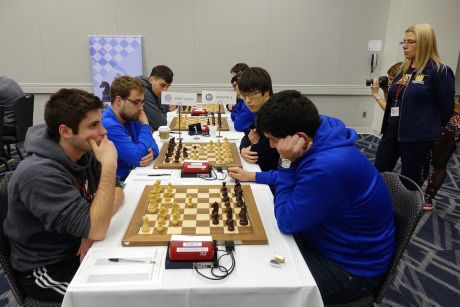
St. Louis (left) vs. Webster A-team (right) in the critical round five. Webster Coach Susan Polgar observes.
Our own U of T Team A finished with 3.5 points out of 6 games, losing only to UTD’s Team A and Webster’s Team B, both of which are made-up exclusively of Grandmasters. This performance earned our University the precious trophy of Top International Team, despite the tough competition with other International Teams (e.g. from Canada, Mexico etc).
Univ. of Toronto A was the proud winner of the Top International Team Award!
Also good was the result for the Team B, which scored 2 out 6, missing at least two opportunities to score even more but still climbing higher than its starting rank in the final standings!
“Cheese!” UofT B’s players are smiling at the camera!
2017 Pan-Am Intercollegiate Team Championship | Final Standings (Top 15)
All of the top nine teams are “scholarship schools” and invest heavily in hiring renowned coaches and in recruiting and training student athletes from all over the world. In fact, some of Canada’s strongest players, such as Grandmasters Anton Kovalyov and Razvan Preotu as well as Edward Song, have joined the chess teams of these well-endowed American Chess Universities. “My concern for our team is being able to keep someone once they reach GM status”, wrote Steve Wolk, Chess Manager for Lindenwood University. “Other schools can offer huge scholarships that I cannot do.” Lindenwood’s Board 1 used to be GM Priyadharshan Kannappan, back when he was an IM. Now, however, Kannappan plays for Webster University. The highest-finishing schools that do not offer robust chess scholarships all tied with 4.0/6 and finished from 10th place onward: University of Michigan, Harvard University, University of Chicago (two teams with 4.0/6), Arizona State University, and the University of Illinois.
Canadian GMs Anton Kovalyov and Razvan Preotu are both playing for UT Dallas!
What about the others?
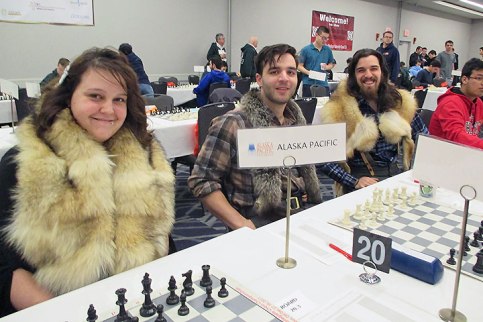
During the early rounds, two teams new to the Pan-Am caught our eye, literally. Alaska Pacific University (Anchorage, AK) intended to have a four-person team but one player could not make the trip due to a family emergency. Participating were Board 1 Jonathon Singler, Board 2 Carson Kent, and Board 3 Emily Smith. The team had a rugged outdoor look suitable for representing a university from “the last frontier” state. For round 1, each player wore a gray long-sleeved shirt with the school logo and the men wore suspenders. For round 2, the players had furs around their necks and the men had plaid, flannel, lumberjack-style shirts. After their games, all three players would lose their fancy outfit, replace it with their bathing suits and go straight to the hotel swimming pool!
Stylistically speaking, Alaska Pacific really set itself apart from any competition!
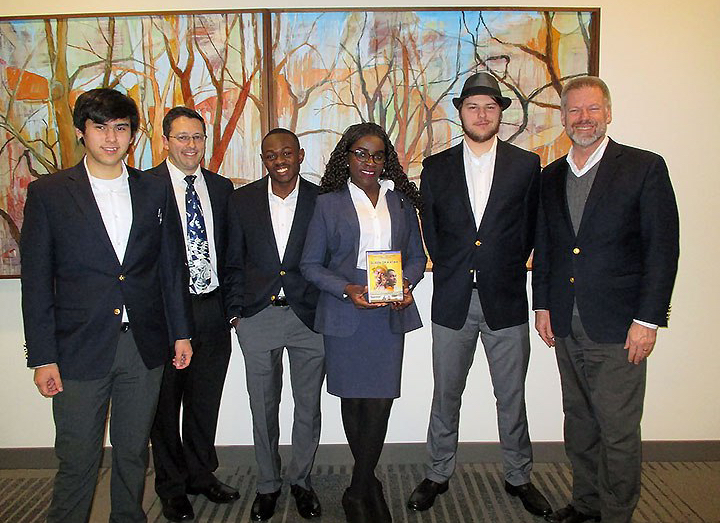
In contrast, players from Northwest University (Kirkland, WA) wore blazers and dress shoes. The Northwest University chess club president is Phiona Mutesi. Her life story was told in a book that then became the basis for the Disney movie “Queen of Katwe”. Mutesi plays second board behind chess expert Benjamin Mukumbya, who also has a counterpart in the Disney film. Rounding out the team is third board Walter Borbridge, who is from Sitka, Alaska, and is one of a few hundred Tlingit speakers in the world. The fourth board is Andrew Uptain, who is a community college transfer to Northwest University and the only non-freshman member of the team. Northwest University paid for the team’s travel, hotel, entry fees, food, and uniforms, according to Northwest University President Joseph L. Castleberry, Ed.D. “In the Pan-Am, Northwest University students have the opportunity to play superior players and grow in their chess skills”, said Castleberry, who is looking forward to the chess club and chess team expanding in the coming years!
The Queen of Katwe (Phiona Mutesi) played on board 2 of Northwest University
Finally, aside from University of Toronto, this year’s PanAm saw two more Canadian Universities participating, Queen’s University and Western University! Led by the always friendly Simon Gladstone, Queen’s even managed to win one of the tournament’s team awards!
Queen’s University won the award for Top V Team (U1600)
Just as – if not even more – impressive was the participation of Universidad Tecnologico Nacional de Mexico with three (!) teams, whose Team A put up a strong fight against but ended up losing to our own Team B for round 5 of the tournament.
The three teams of Tecnologico Nacional de Mexico
The Event
The hospitable organizer of the 2017 PanAm, on behalf of Ohio State, was Kelly Bloomfield. In a phone interview he gave before the Pan-Am, Bloomfield said that the two largest Pan-Ams in history (108 teams in 1972 and 123 teams in 1975) were in Columbus. While the Pan-Am is not as popular now as it was during that “Fischer Boom,” Bloomfield was hoping for a turnout as big as the 60 teams at the 2016 New Orleans Pan-Am and indeed he made it! As the Chess Advisor for Ohio State, Bloomfield assembled two teams for the 2017 Pan-Am. Bloomfield’s multiple Pan-Am roles (organiser, tournament director, DGT broadcaster, advisor) convinced him to take the week of December 25th to January 1st off from his full-time job as building automation manager. His dedication to the organization of the tournament really paid off!
The amazing organizer of the 2017 PanAm, Kelly Bloomfield
Indeed, everything was wonderfully organized! The teams were accommodated at Hyatt Regency, a beautiful and fully accessible luxury hotel, conveniently located just a 10-minute drive from Columbus International Airport. The hotel had indoor access to the playing hall and offered a wide choice of food places, where the players could take their breakfast and lunch. This amenity proved very convenient, given the Narnian December temperatures in Columbus.
Despite the cold weather, our Team did not miss the chance to visit the local pubs for dinner
The most impressive thing about the tournament organization, however, was the breathtaking playing hall. The incredibly spacious and bright Greater Columbus Convention Center is an architectonic wonder of modern design. It featured more than 10 rooms – one for the games, one for live broadcasting, one for analysis, another one was reserved for the Webster Teams to Practice etc – and ample space for the players to feel more than comfortable during the competition. We were really impressed when we first saw the playing venue during registration and the Opening Reception. Bloomfield spent $5,000 on a menu that included hors d’oeuvres and pulled pork sliders.
Could the playing hall get any better than the Greater Columbus Convention Center?
All games started exactly on time and the organizers generously introduced new categories of outstanding team and individual performance, for which they awarded prizes! At the end of the tournament, in lieu of a souvenir, each participant received a vinyl, 2017 PanAm chess board with the scarlet and gray Buckeye logo! Scarlet and gray are the official colors of Ohio State and its residents are known as Buckeyes (as are the sports teams at Ohio State).
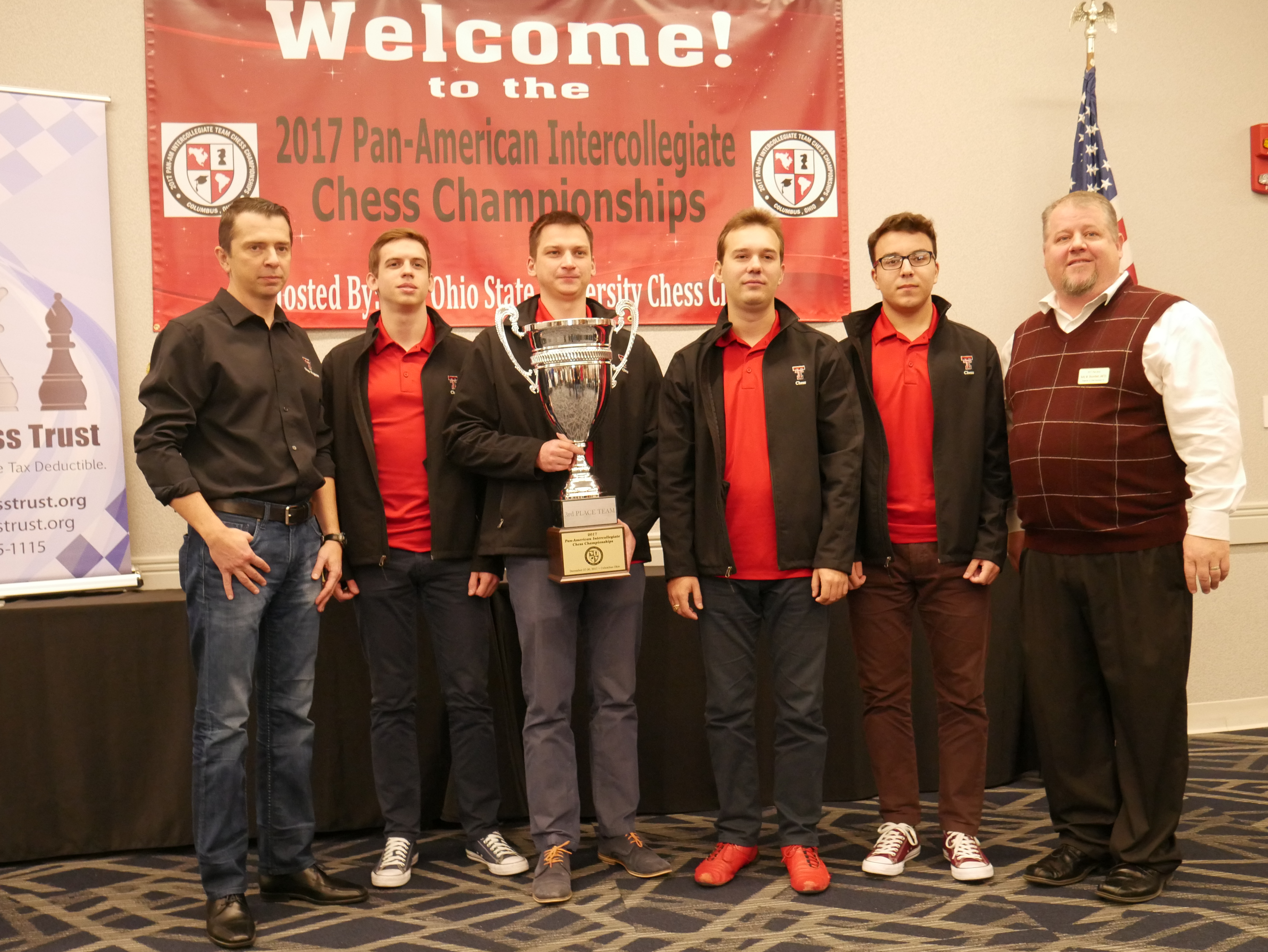
This year’s Award Ceremony was pretty shiny!
Of course, the tournament would not have been such a great success without the work of a group of people, including – first and foremost – Kelly Bloomfield but also College Chess Committee Chair Al Lawrence, Chief Floor Tournament Director Kathy Lin and Chief Tournament Director Grant Perks. The Executive Board of University of Toronto’s official Chess Team would like to pass their warm and grateful thanks to the team of hosts for their hospitality, hard work and exemplary organization.
Chief Floor TD Kathy Lin with a bunch of Buckeye Chess Boards
Our small suggestions for making the tournament even better in the future would be to improve the official website of the tournament. For example, the presentation of the results/pairings could look better and be more user-friendly, a photo gallery could be added etc. Other than that, the tournament was perfect and our University’s Chess Club is looking forward to visiting Columbus again in the future!
And the Oscar goes to….!
On our way back to Toronto, a chess civil war broke out at Columbus International Airport between the players of our team but as you can see here, despite the gory violence everybody survived and returned home safe! 🙂
Next year’s PanAm will be held in San-Francisco, California, Dec. 27-30! Need I say that we can’t wait to participate?
Starting on November 17th and going until December 15th, Hart House Chess Club ran a 5-step workshop for students, who wished to learn how to play chess! The lessons were taught by our experienced Coach and ex-Varsity player Jonathan Yu and were very popular, especially among female students!
The topics included: the Pieces and their Movements, Check, Checkmate, Stalemate, Algebraic Notation, Basic Pawn-less Endgames, Basic Tactical Themes and Chess Pattern Recognition!
At the end of the course Jonathan offered one chess book to each of his students, encouraging them to keep studying and improving! Hart House Chess Club would like to offer its most grateful thanks to him for his amazing and dedicated voluntary work and for his pro-bono contribution towards spreading chess across the student community!
Sincere congratulations are also owed to each and every student of his (almost) all-female class! See you all next semester!
Starting on September 22nd and going until December 8th, Hart House Chess Club ran a 12-session workshop for intermediate skill-level players who wanted to step up their game! The lessons were taught by our Varsity player Panayoti Tsialas and attracted a big number of dedicated students!
Below are the themes examined in class:
I. Tactics:
Knight Forks
Double Attacks
Deflection/Decoy
Promoting the advanced passer (as a tactical element)
Spotting stalemate as a defensive resource
Unnecessary resignations where a defense was still available
Cacvalry Charge: Mating with two Knights
II. Opening Theory
Basic Opening Principles: a) Centralize, b) Develop, c) Castle
Moving the same piece twice and trading our developed pieces for undeveloped ones
Morphy’s genius and the importance of rapid piece development in the opening
III. Middlegame Strategy
Wilhelm Steinitz and the Scientific Method in Chess: Material, Time, Space and the Theory of Balance
Wilhelm Steinitz and the Principle of Attack – The evaluation of the present position determines what the right plan is: a) Slight Advantage: Accumulate more Small Advantages, b) Large Advantage: Accumulate more small advantages and prepare an attack, c) Winning Advantage: Launch an attack and attack the points where the opponent’s chain is weakest. The grievous consequences of violating this principle (e.g. attacking in an equal position)
The nature of the advantage (e.g. slight, large or decisive / temporary or permanent) and how to exploit it
The strategic importance of the open -h- file when attacking the enemy king and how to open it
Material asymmetries: A queen versus three minor pieces. Who wins?
Siegbert Tarrasch’s steps against the hanging pawns: stop, block, terminate.
The classical isolated d4 pawn: standard plans when you play with or against it (e.g. trade/not trade etc)
IV. Endgame Theory:
Converting an extra pawn in the endgame
V. Other Topics:
Chess Analysis – A Simulation Exercise: Avoiding mistakes by re-constructing a player’s decision-making process in real-tournament circumstances (analyzing games and positions from the Pan-Am Qualifier)
The elements of a proper tournament schedule and how to build it (showing games from tournaments where a stronger player keeps playing weaker opponents or a weaker player keeps facing stronger opponents)
The art of calculating long, forced lines and how to master it
At the end of this long course, in lieu of a goodbye gift, Panayoti invited all his students to a simultaneous chess exhibition, in which they got to challenge him on the board, demonstrating their newly acquired knowledge! Attendees did not miss the chance to taste Panayoti’s homemade Greek-salad with plenty of feta and delicious Kalamata olives from his hometown!
At the end of the 4-hour long simultaneous exhibition, Panayoti and his students analyzed each of the games for an additional, super-filling 5-hour post-mortem at the Reading Room!
Panayoti would like to personally thank his students: Vignesh Kumar, Beatrice Ballarin, Adam Kasztenny, Morgan Wolfe, Amar Singh, Raeid Saqur, Kevin Chen, Sahan Karunaratne, Nikolaos Mitrousis, Jose Acosta, Vivian Li, Chrysafis Tsoukalas, Seiji Nakagawa and Bilal Sandeela for their active participation in his Intermediate Chess Class!
Starting on September 22nd and going until December 8th, Hart House Chess Club ran a 12-session workshop for beginner players who wanted to improve their game! The lessons were taught by our Varsity player Panayoti Tsialas and attracted a big number of passionate students!
The lessons examined the following topics:
I. Tactics:
Knight Forks
Tactical Rook Endgames (skewers + mating nets)
Back rank mates
The mate on g7 (g2) – Pattern Recognition: a) King has castled short, b) The -g- pawn has been pushed, c) The fianchetto bishop has been traded off or is exiled on the other side of the board, d) Queen invasion and collaboration with Pawn or Bishop (less frequently with Knight)
Creating Mating Nets: Mates in two with a non-checking first move
II. Opening Theory
An early Queen sortie and how to punish it
Pushing the -f- pawn and the weakness of the f7 (f2) square
Neglecting piece development in the opening
Moving the same piece twice in the opening
Starting out 1. e4 e5 – The Italian set-up and some basic ideas and common mistakes for White and Black
III. Middlegame Strategy
Wilhelm Steinitz and the Scientific Method in Chess: Material, Time, Space and the Theory of Balance
The attack against the enemy’s castled king and its proper preparation. Three conditions for a successful attack: a) Superiority or at least control of the centre, b) Have more attacking pieces on your opponent’s king that he has defenders, c) There must be a weakness on the opponent’s camp (e.g. one of the -f-, -g-, -h- pawns has been pushed)
Attacking plans against the king who has not castled: a) Attack down the -e- file, b) Attack via -f7- square, c) Preventing castling
Refuting a premature king attack: breaking the centre open
The “fishbone”: Splitting in two your opponent’s army by thrusting a pawn into his camp
IV. Endgame Theory:
Calculation v. Schematic Thinking: The rule of the square
The peculiar case of the -h- passed pawn
V. Other Topics:
Chess Analysis – A Simulation Exercise: Avoiding mistakes by re-constructing a player’s decision-making process in real-tournament circumstances (analyzing games and positions from the Pan-Am Qualifier)
The tripartite classification of openings (open, semi-open, closed) and how to build your opening repertoire
At the end of this long course, in lieu of a goodbye gift, Panayoti invited all his students to a simultaneous chess exhibition, in which they got to challenge him on the board, demonstrating their newly acquired knowledge! Attendees did not miss the chance to taste Panayoti’s homemade Greek-salad with plenty of feta and delicious Kalamata olives from his hometown!
At the end of the 4-hour long simultaneous exhibition, Panayoti and his students analyzed each of the games for an additional, super-filling 5-hour post-mortem at the Reading Room!
Panayoti would like to personally thank Alexandra Yao, Luc LeClair, Aidan Hallsworth, Zara Toyserkani, Zoe Fong, Su Sanne Tan, Dean Toyserkani, Mariya Aksyonova, Levon Amatuni, Tomas Hogan, BenJohn Libardo, Spandan Sengupta, Andrew Effat and little Andy for their active participation in his beginner lessons!
From Friday, December 15th through Sunday December 17th, a record number of 175 chess players, organized in six rating-based sections, competed in the 2017 Holiday Open!
Hart House Chess Club was the host of this huge International Open Tournament, which turned out to be the biggest in Toronto over the last five years! Canadian as well as International chess enthusiasts of all ages and skill levels packed the majestic Great Hall and the proud winners shared the very generous prizes, in the total amount of over $7,000!
Most credit for this success goes undoubtedly to our own Alex Ferreira, the amazing Director of the Tournament! Alex has been the heart of the Holiday Open for over a decade and his hard and dedicated efforts have elevated this Open Tournament to one of the most celebrated chess events in all of Canada! This year, Alex ran the tournament with a team of formidable colleagues, each of whom is also worthy of some high praise!
In spite of the big number of participants and the many different sections, which resulted in huge workload, Tyler Longo, the Chief Arbiter of the Tournament, administered the pairings, the results and the standings of each round flawlessly. Chris Knox, the omnipresent Secretary/President of Hart House Chess Club, coordinated everybody’s efforts, making sure that the tournament would indeed be a great success. Jimmy Bartha, our Club’s Treasurer, handled the challenging processes of registration and fee-payment with remarkable professionalism, not to mention that he impressed everyone with the enormous amount of manual labor he put into the tournament. Tasked with advertising, promoting and reporting on the tournament info, our Club’s Director of Communications, Panayoti Tsialas, offered a beautifully designed tournament poster and a rich gallery of pictures and videos, now delicate memorabilia of a successful event. Finally, on every single day of the tournament, our longtime volunteer and U of T alumnus, Andrew MacMillan, was the first one to arrive and the last one to leave the playing hall, bringing in two fully-loaded carts of chess materials, setting up and taking down chess boards, scoresheets and timers for more than 80 boards and making sure that the club’s equipment would not be damaged or lost.
Alex Ferreira & Tyler Longo
This amazing team of volunteers worked together to organize a successful five-round tournament, which will, hopefully, be remembered as a generous service to the chess community both for in terms of its quality as well as in term of its record turnout!
Special thanks is owed to the people at the Hart House Hub (Lynsay, Mauro, Juan, Cynthia and all the others), who were always helpful and friendly in the reception of the players, but our warmest thanks goes out to the parents, who remained with the children-participants throughout the day, making it possible for these young chess-players to practice their favorite game!
In terms of individual results, in the Crown Section, International Master Artiom Samsonkin was first with a perfect score of 5/5 and there followed a 3-way tie for 2nd-4th places between International Master Tomas Krnan, Rohan Talukdar and Geordie Derraugh, with 3.5/5.
In the Under 2200 Section, Markham’s Jeffrey Renfei Zhao finished clear first with 4/5 and five players tied for 2nd-6th places with 3.5/5: Younan Ishow, Benjamin Lin, Andrew Colvin, Max Rusonik and Eric Ning.
In the Under 1900Section, it was Kole Robertson who won gold with a splendid performance of 5 wins in 5 games! Alberto Ranola was second with 4.5/5 and Kevin Yunhong finished third with 4/5.
In the Under 1600Section the amazing Wing Li performed formidably and claimed first place with 4.5/5. Second place was shared by four players who scored 4/5: Hazel Guo, Eric Wang, Michelle Hua and Andrew Ma.
With 4.5/5, Qi Shi was the proud and sole winner of the Under 1300 Section but four more players won prizes by scoring 4/5, thereby tying for 2nd place: Andrew Wang, Dania Surya, Daniel Yuan and Dennis Tran.
Finally, the Under 1000 Section saw four (!) gold medalists, each of whom scored 4 points in 5 games: Firas Dib, Valerie Ruchinskaya, Sarah Chi and Neal Nian Li.
For the complete List of Participants and for a a full record of the Pairings, Results and Final Standing in each Section of the Tournament, click on following links:
You can also check out the Photo Gallery and a couple of videos about the Tournament (here, here and here).
Many thanks to every person who contributed to the success of the 2017 Holiday Open (players, organizers, parents) and congratulations to the winners of the respective sections!












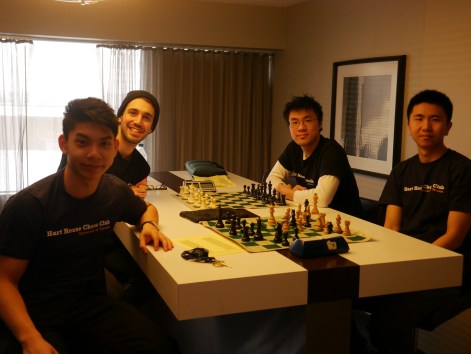















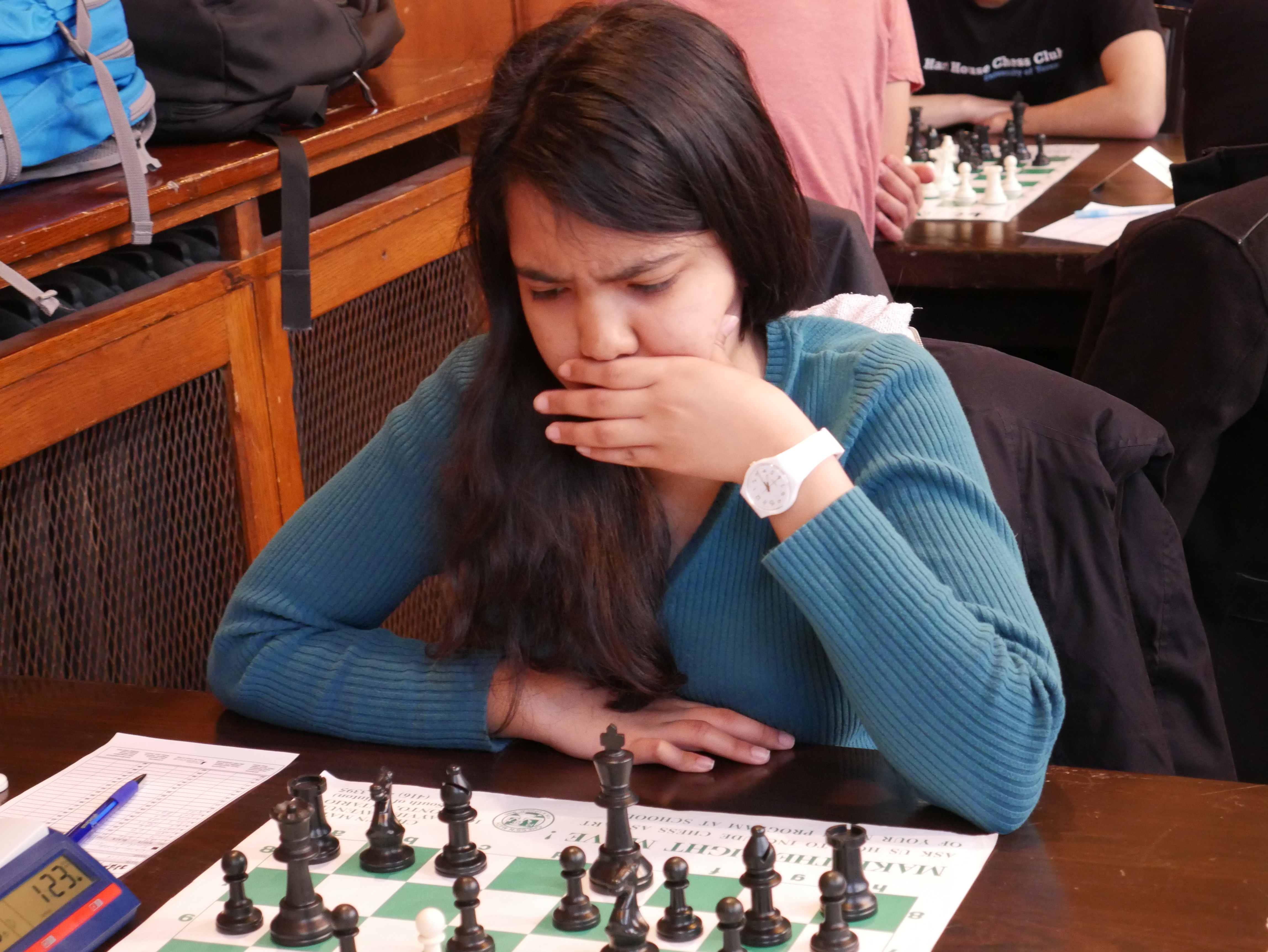


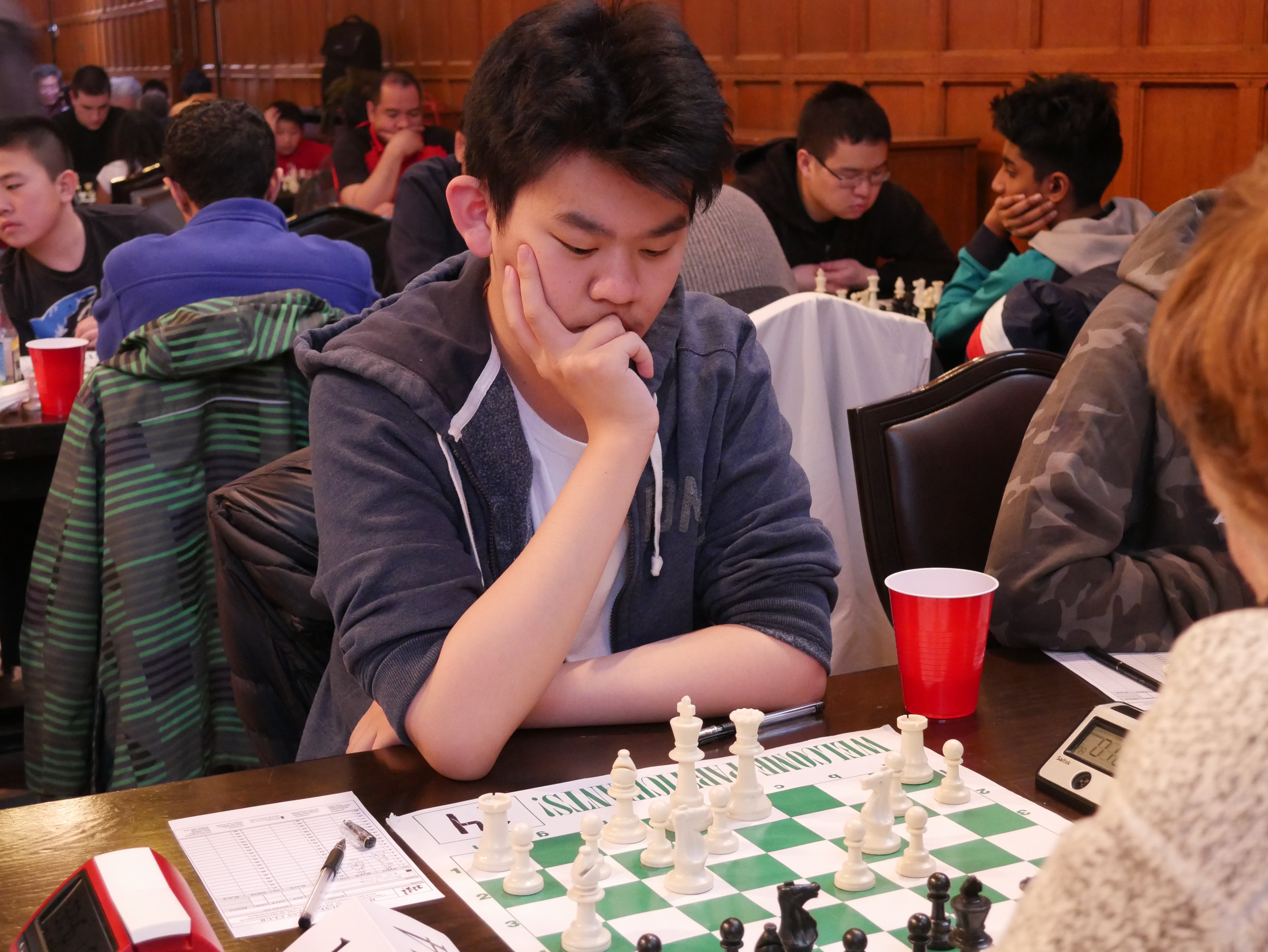

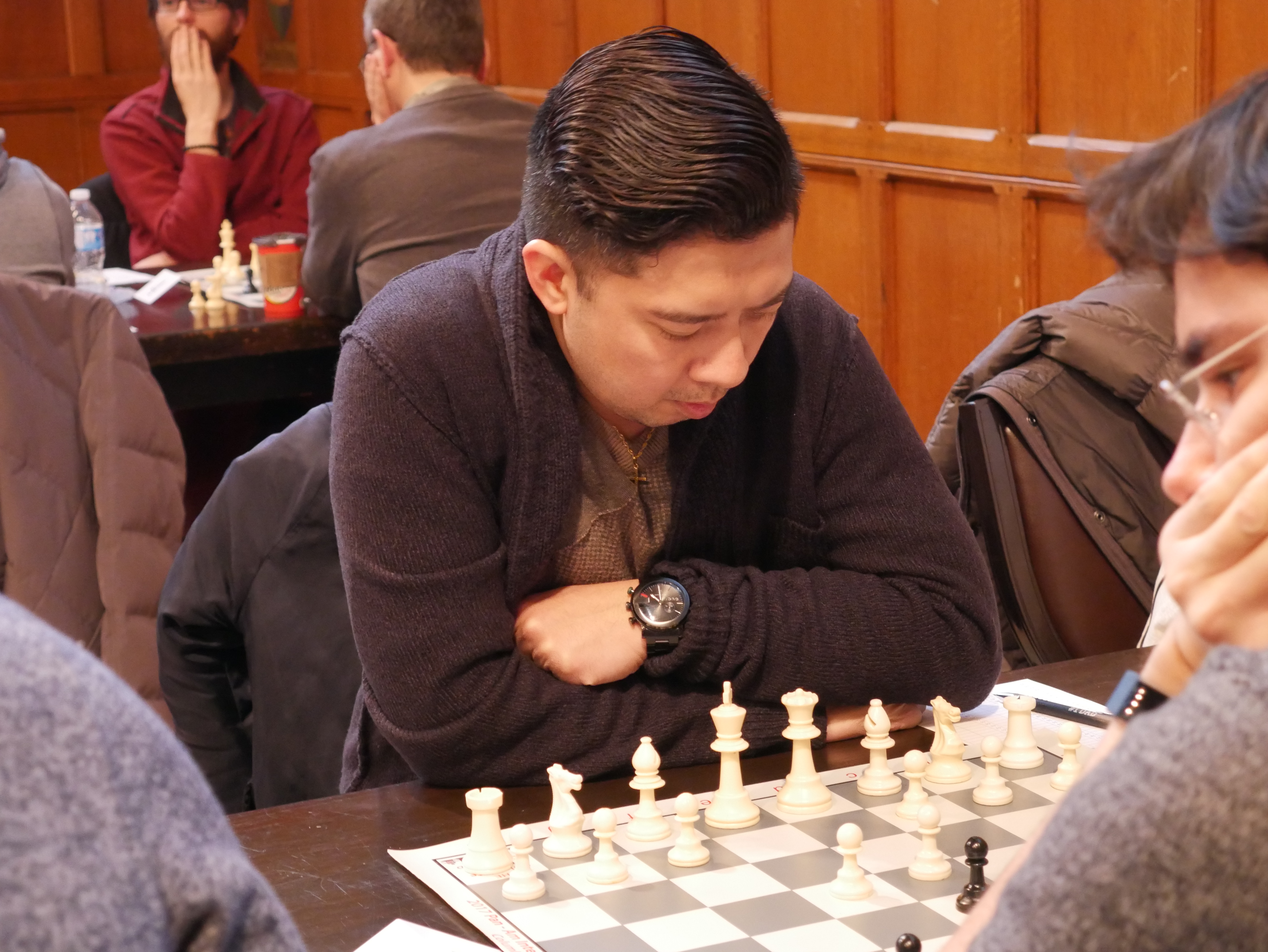


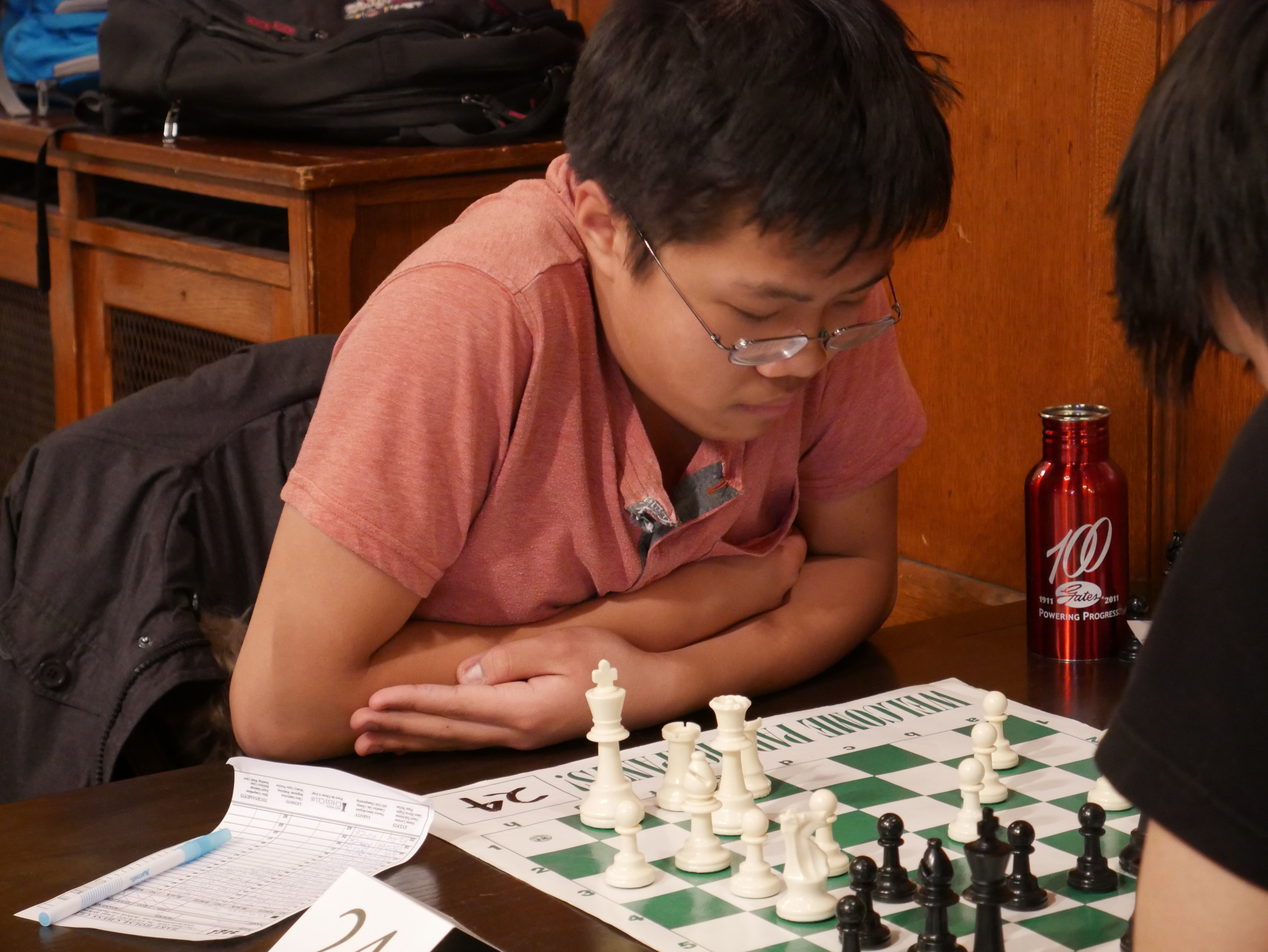









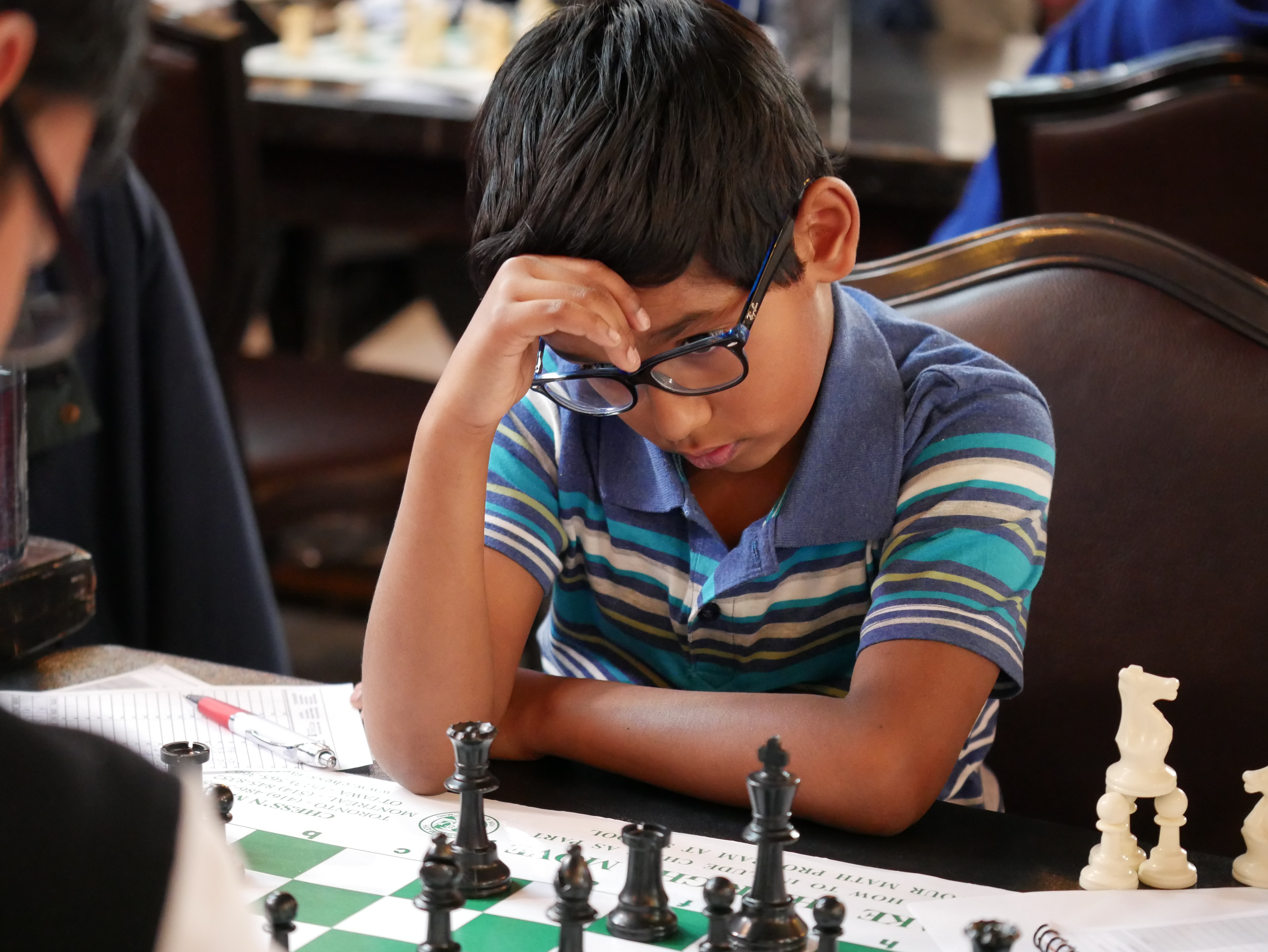


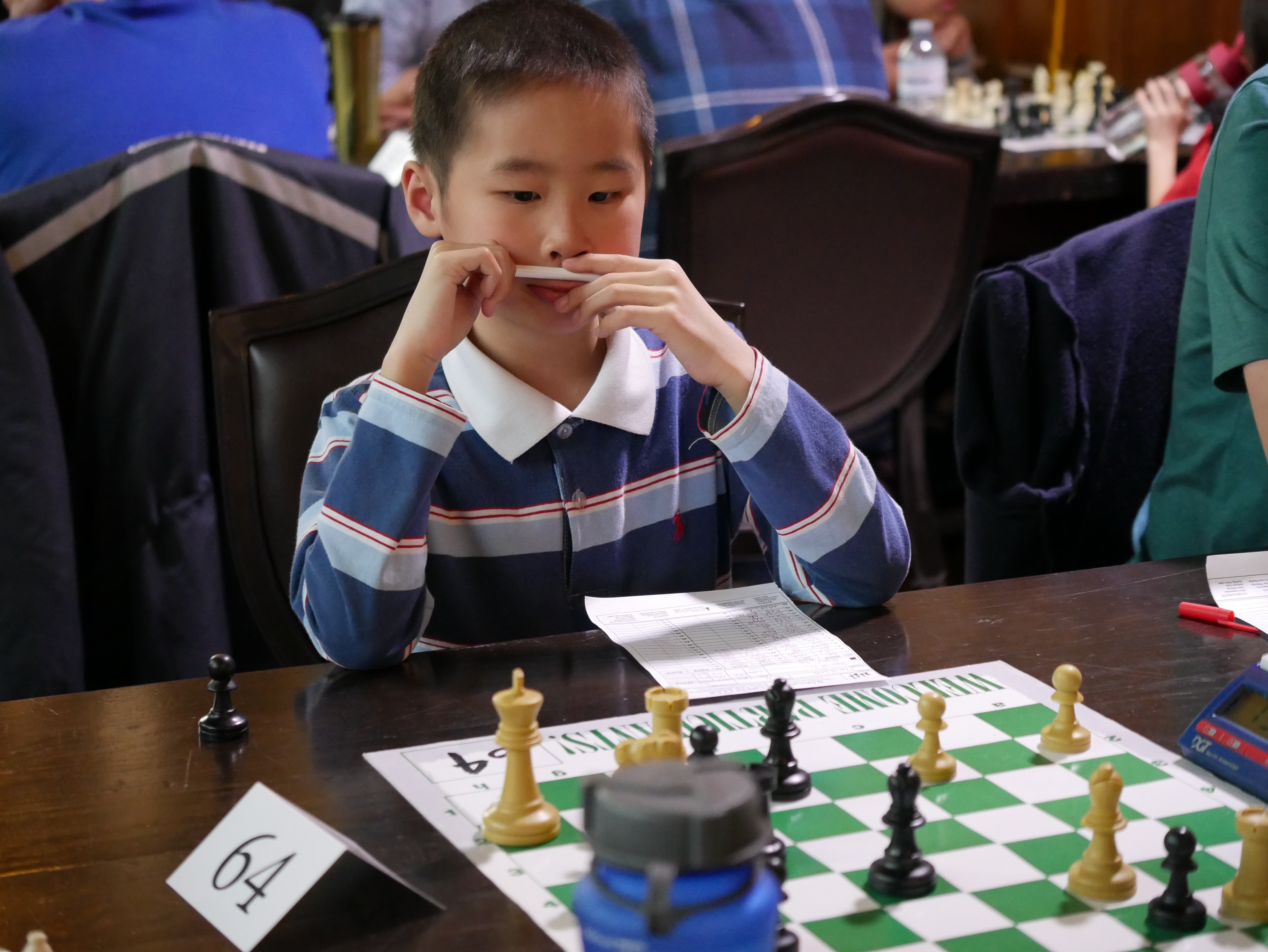


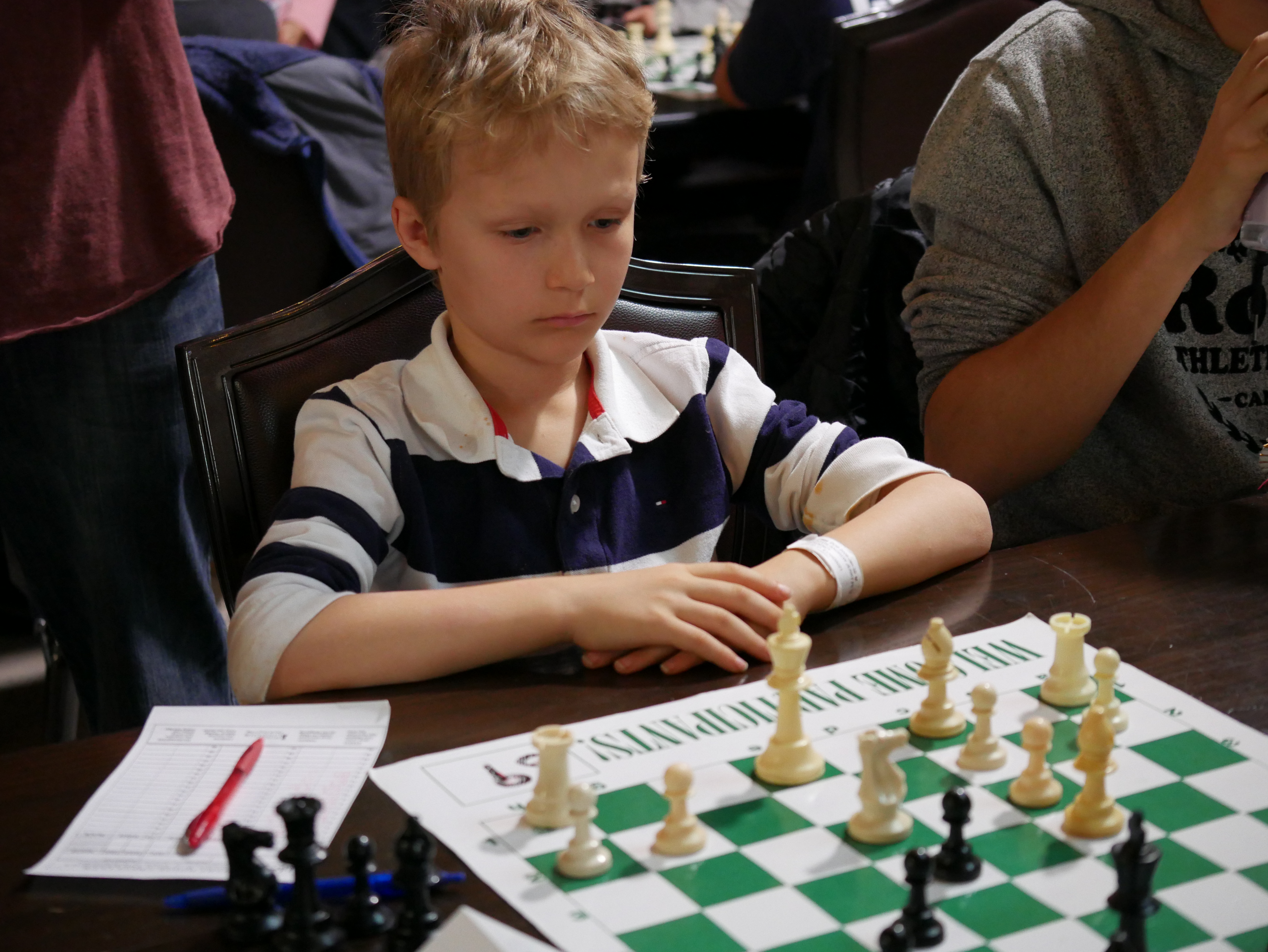


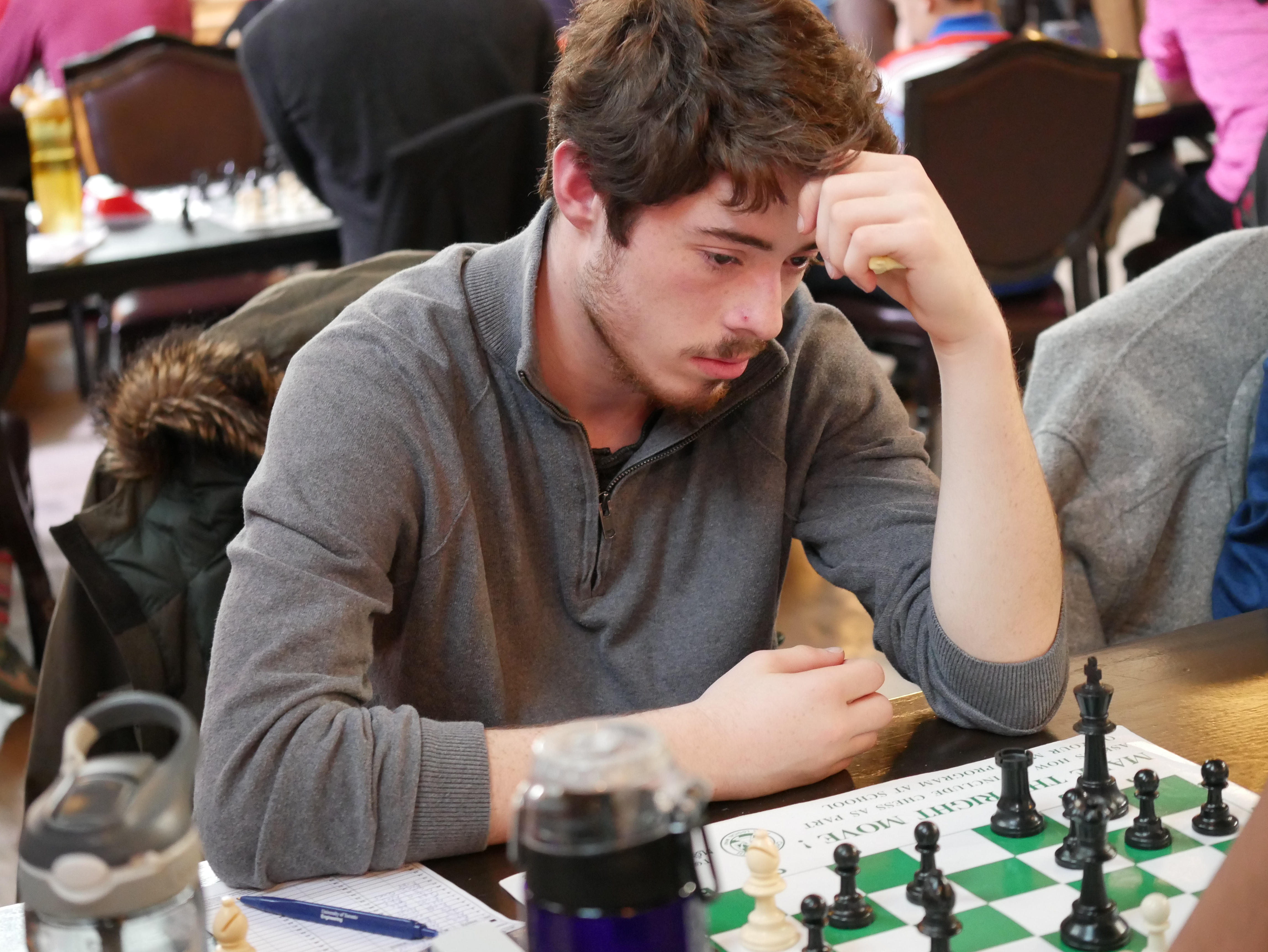
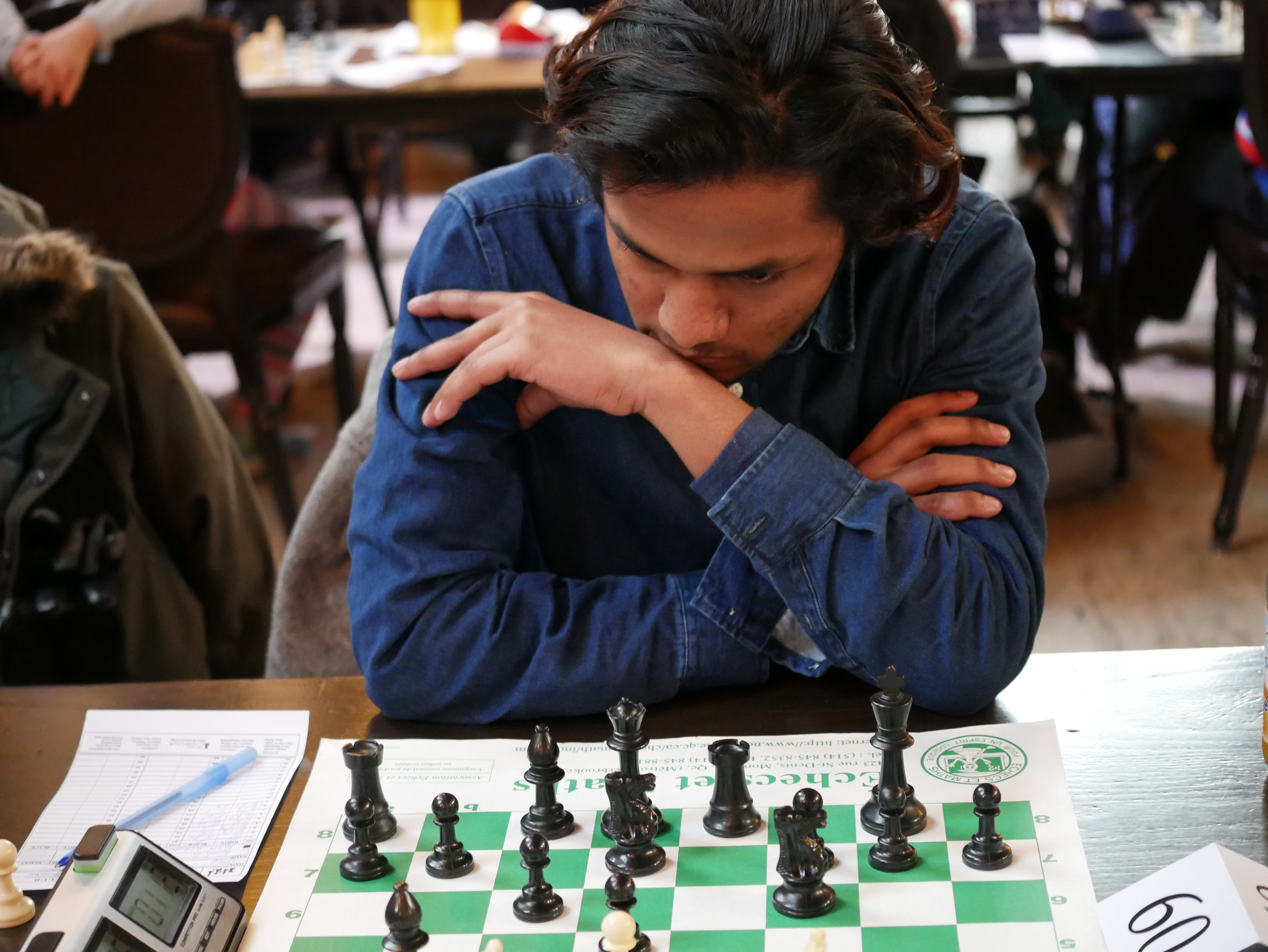


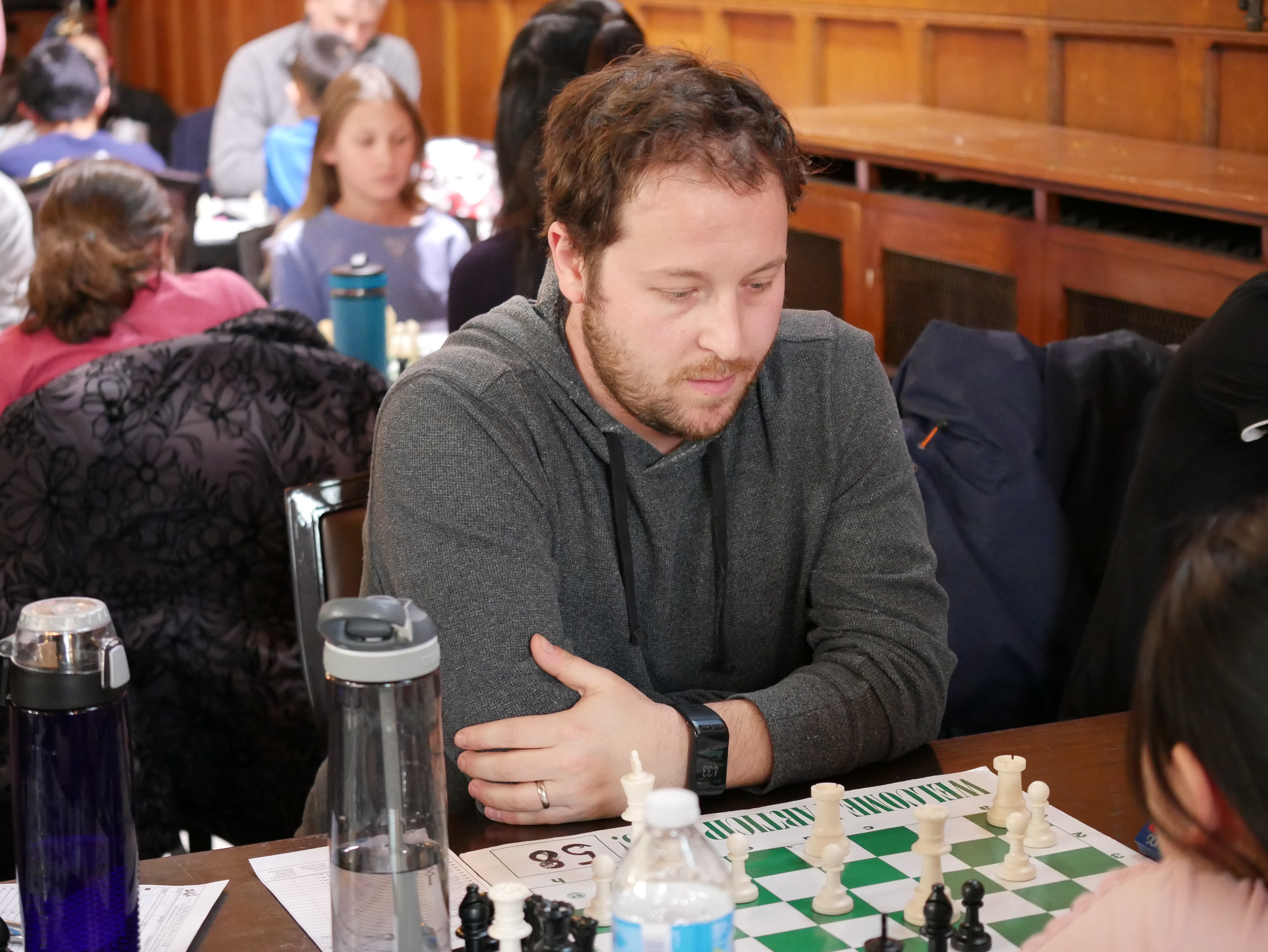
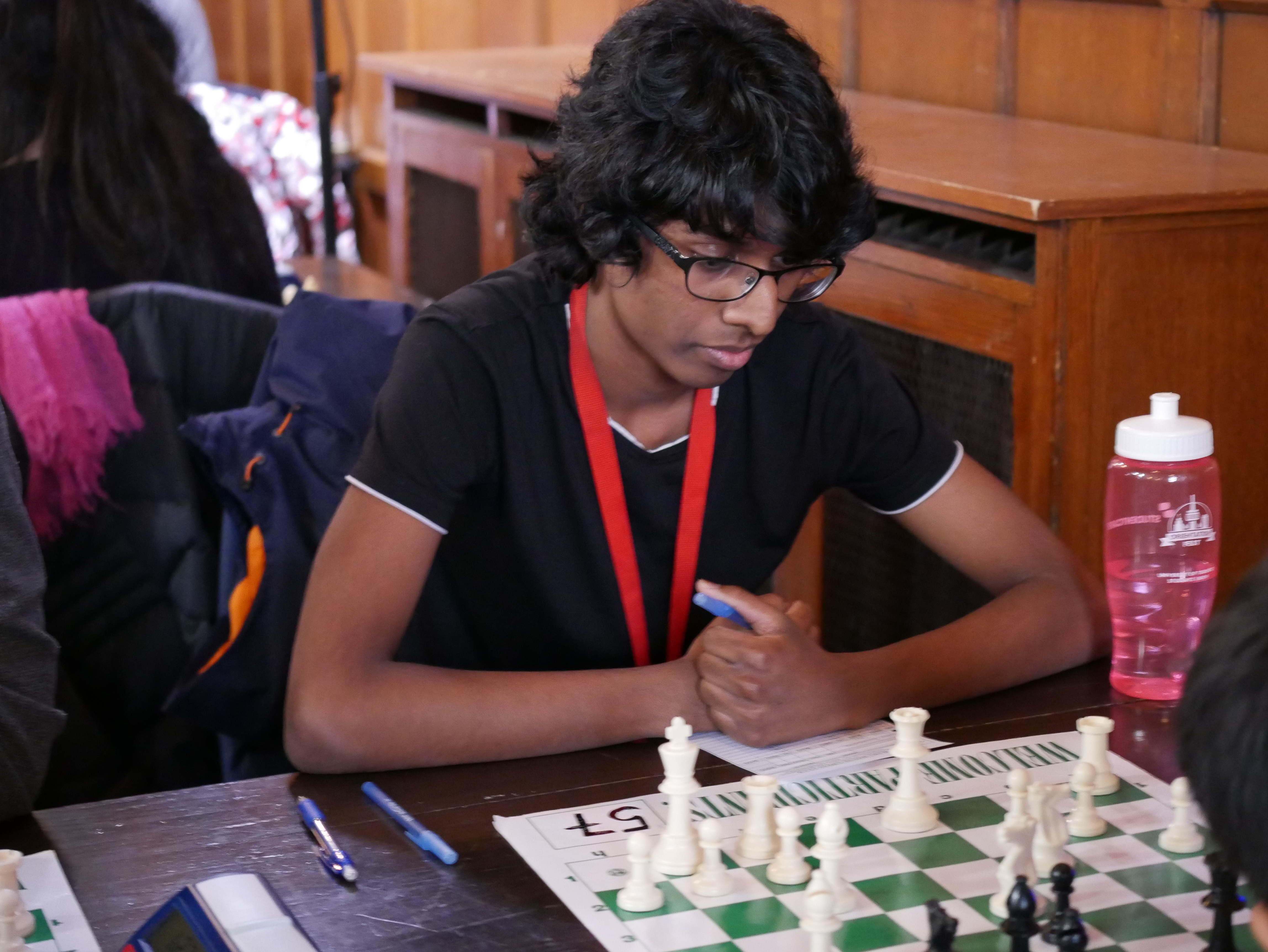


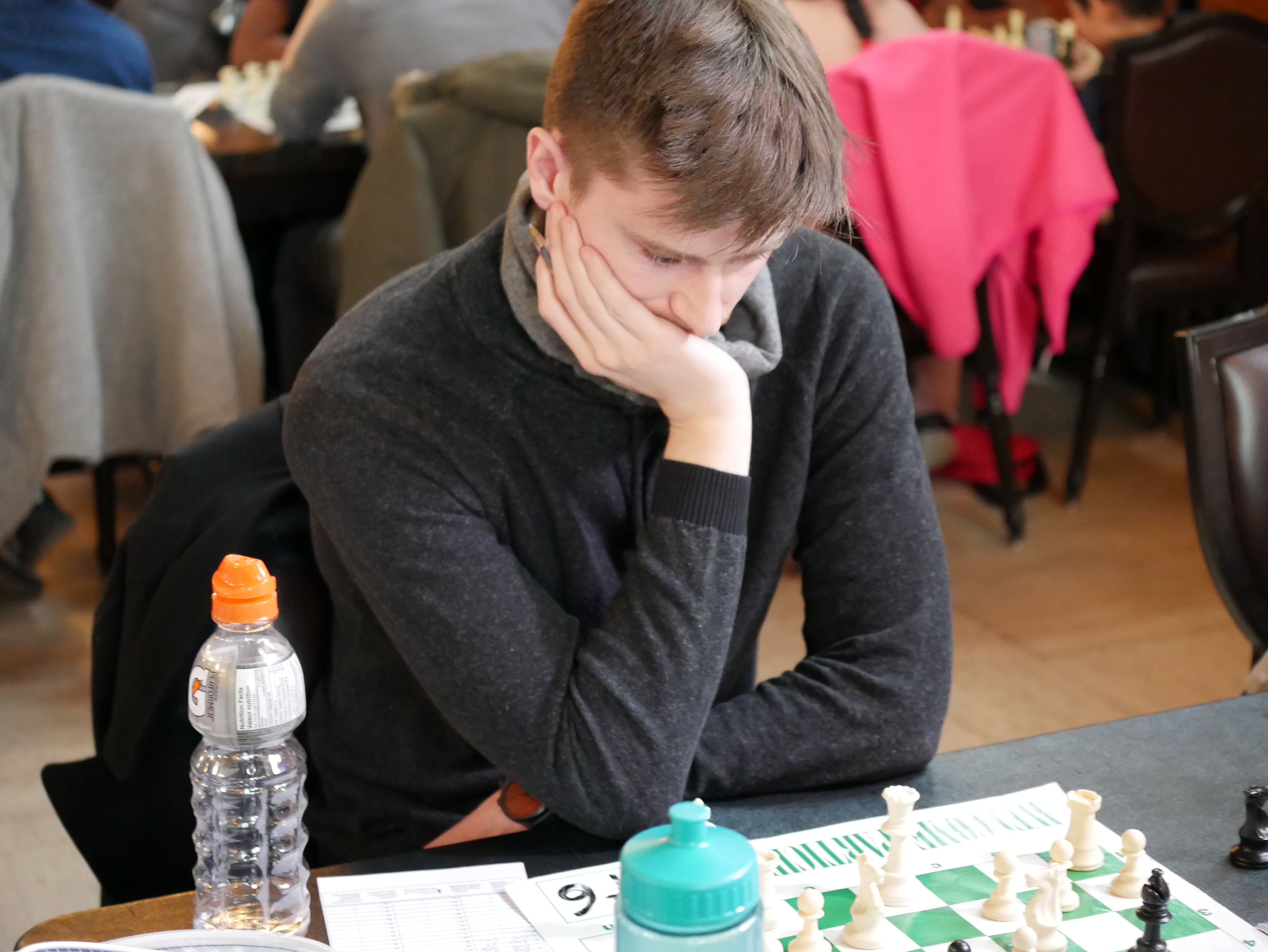







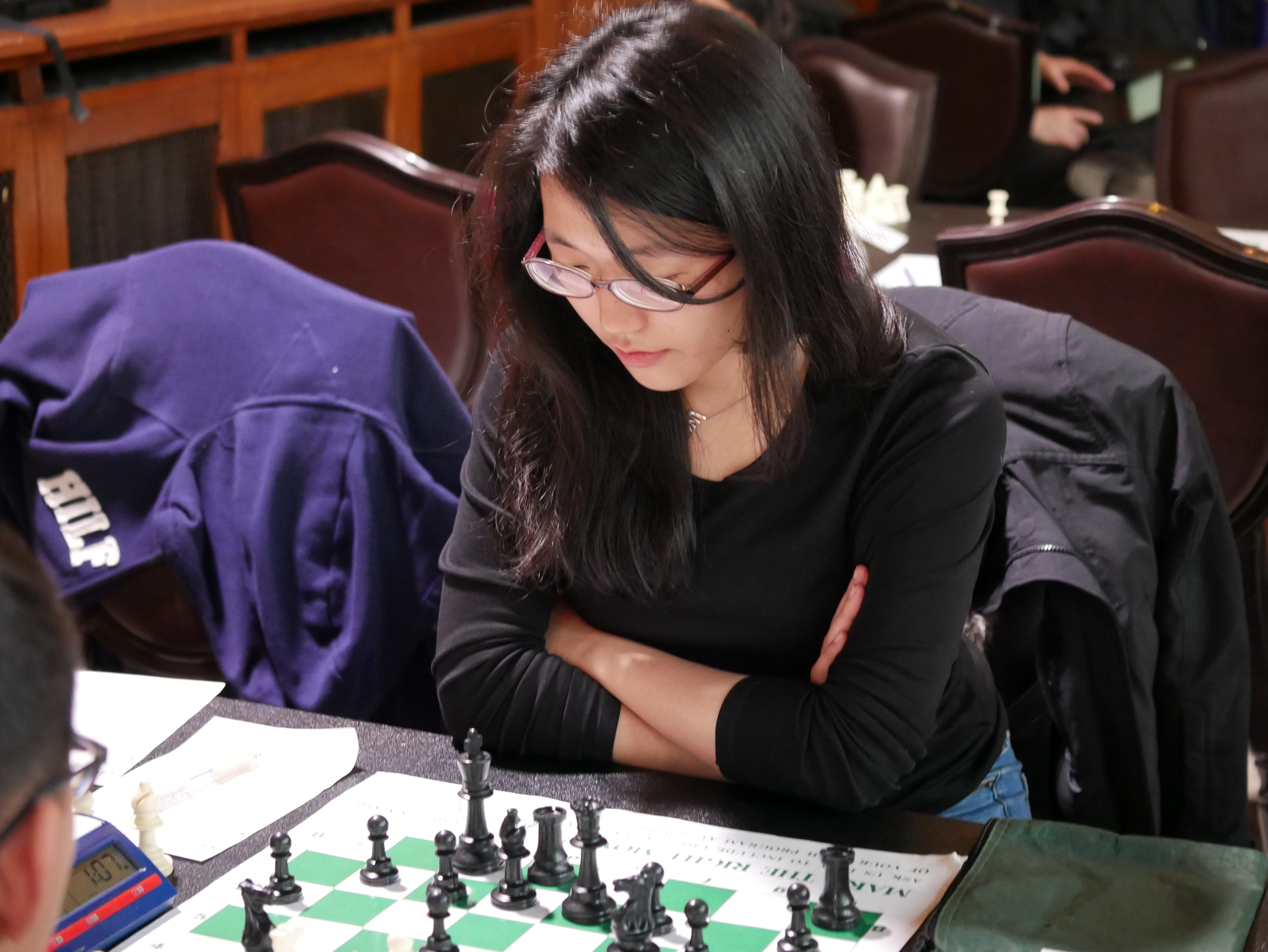

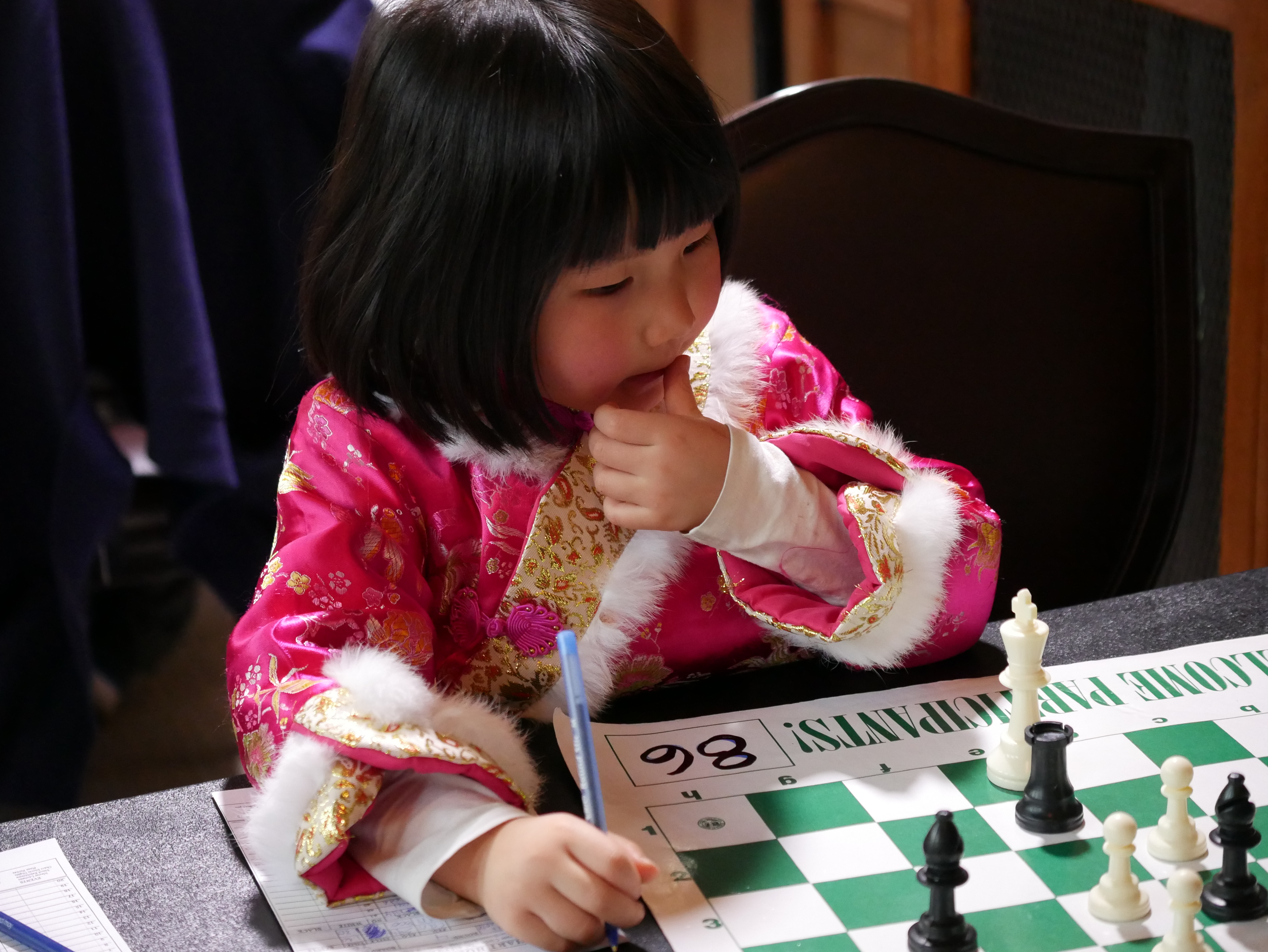


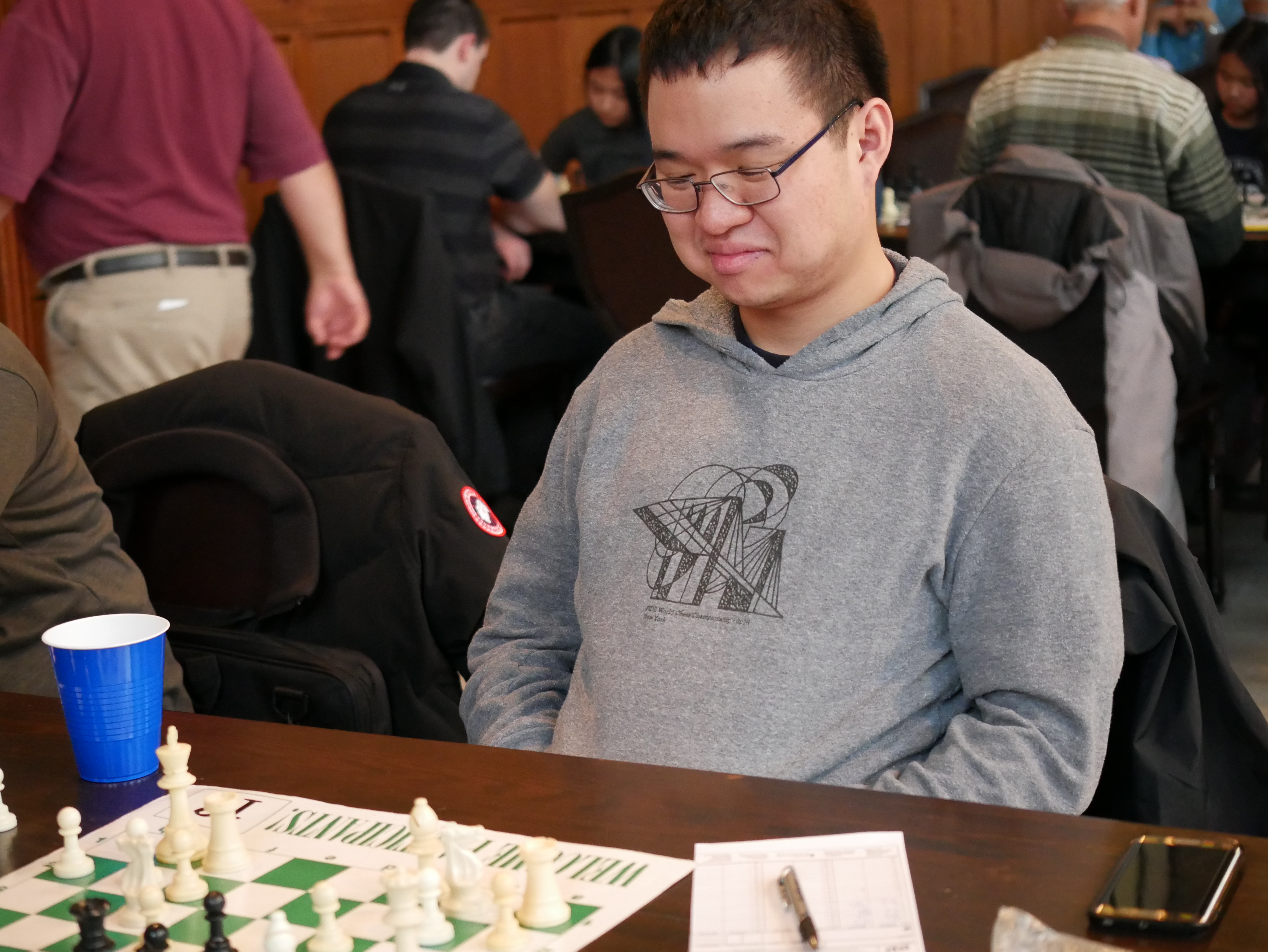
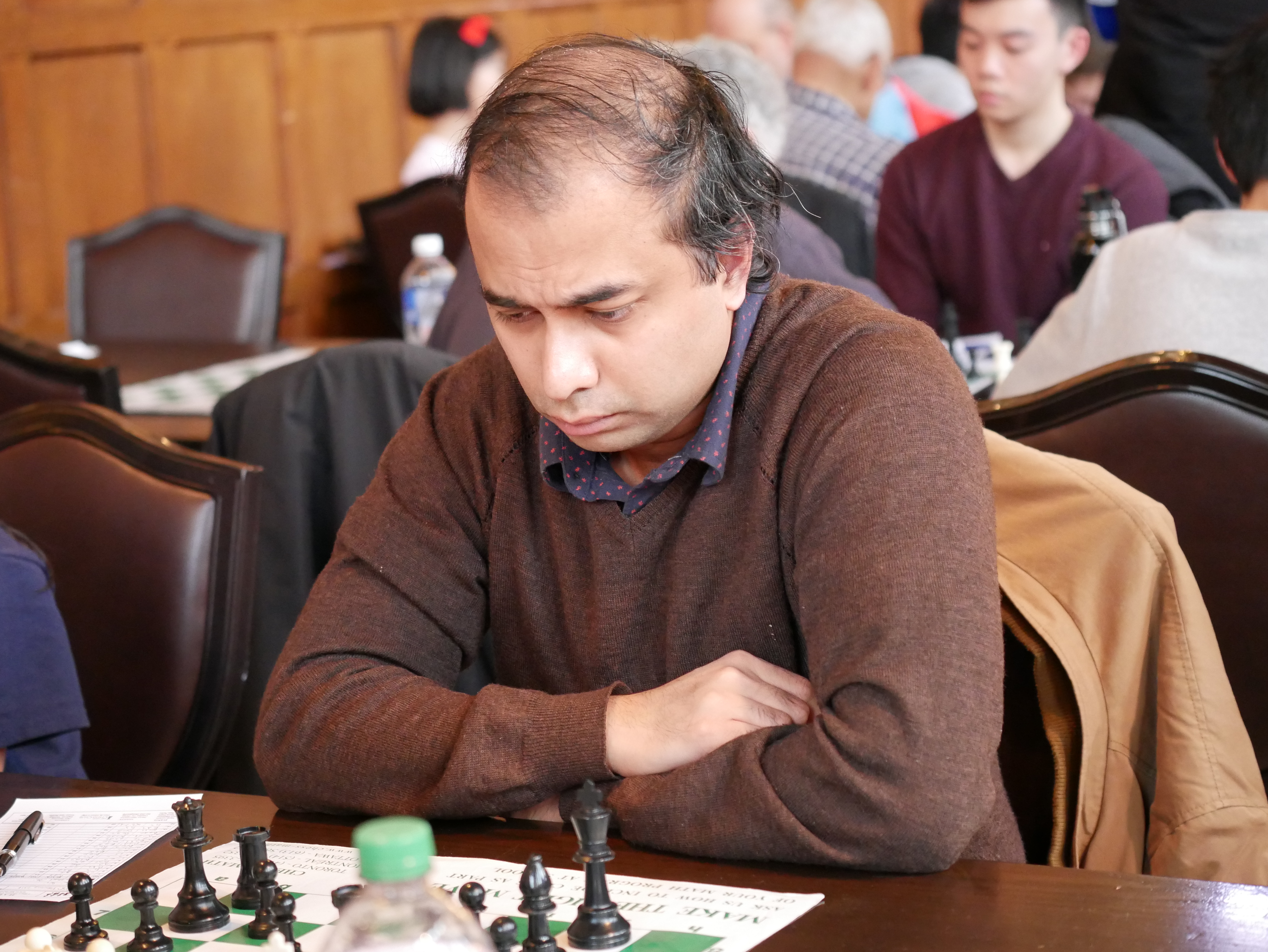

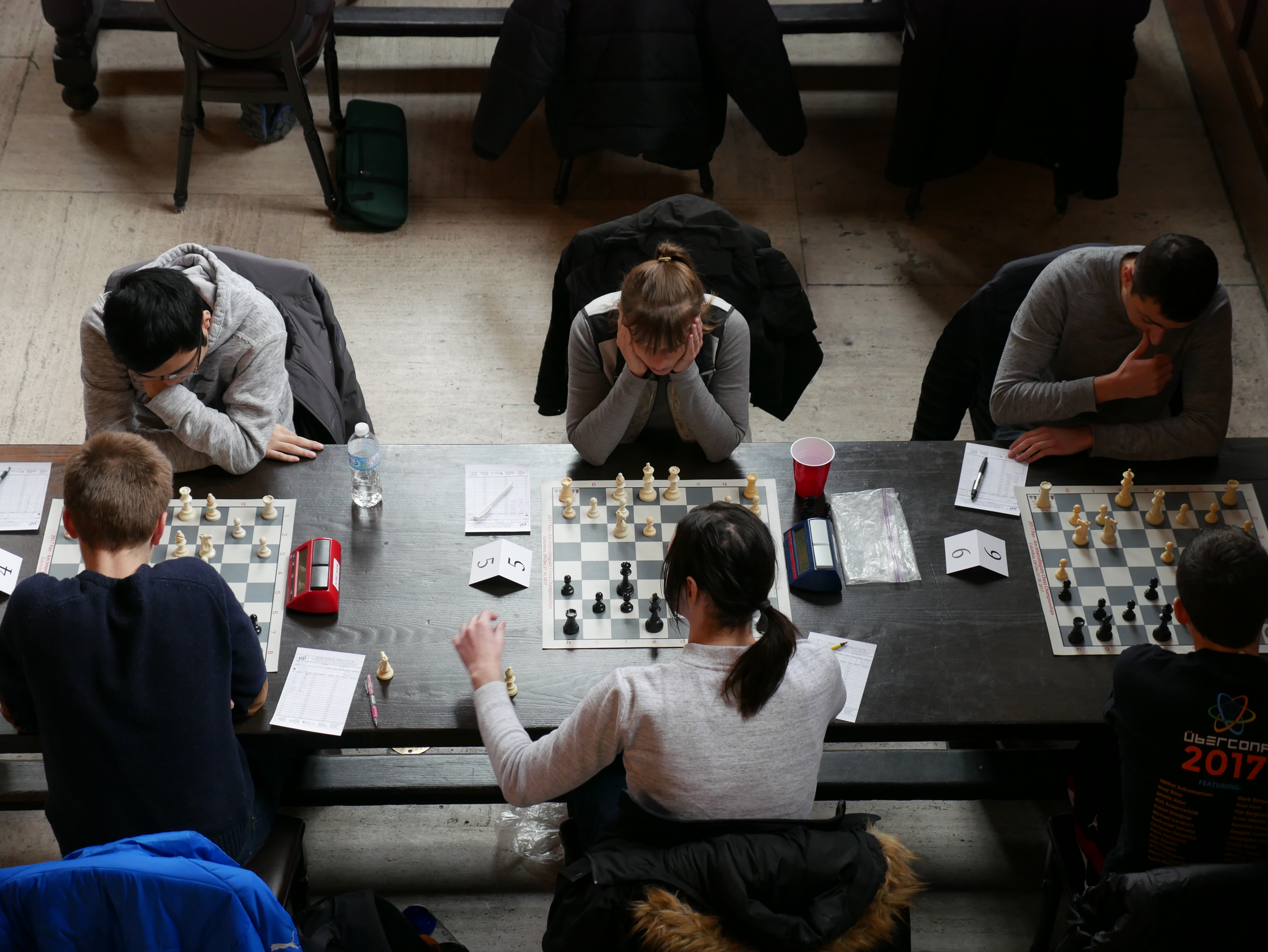
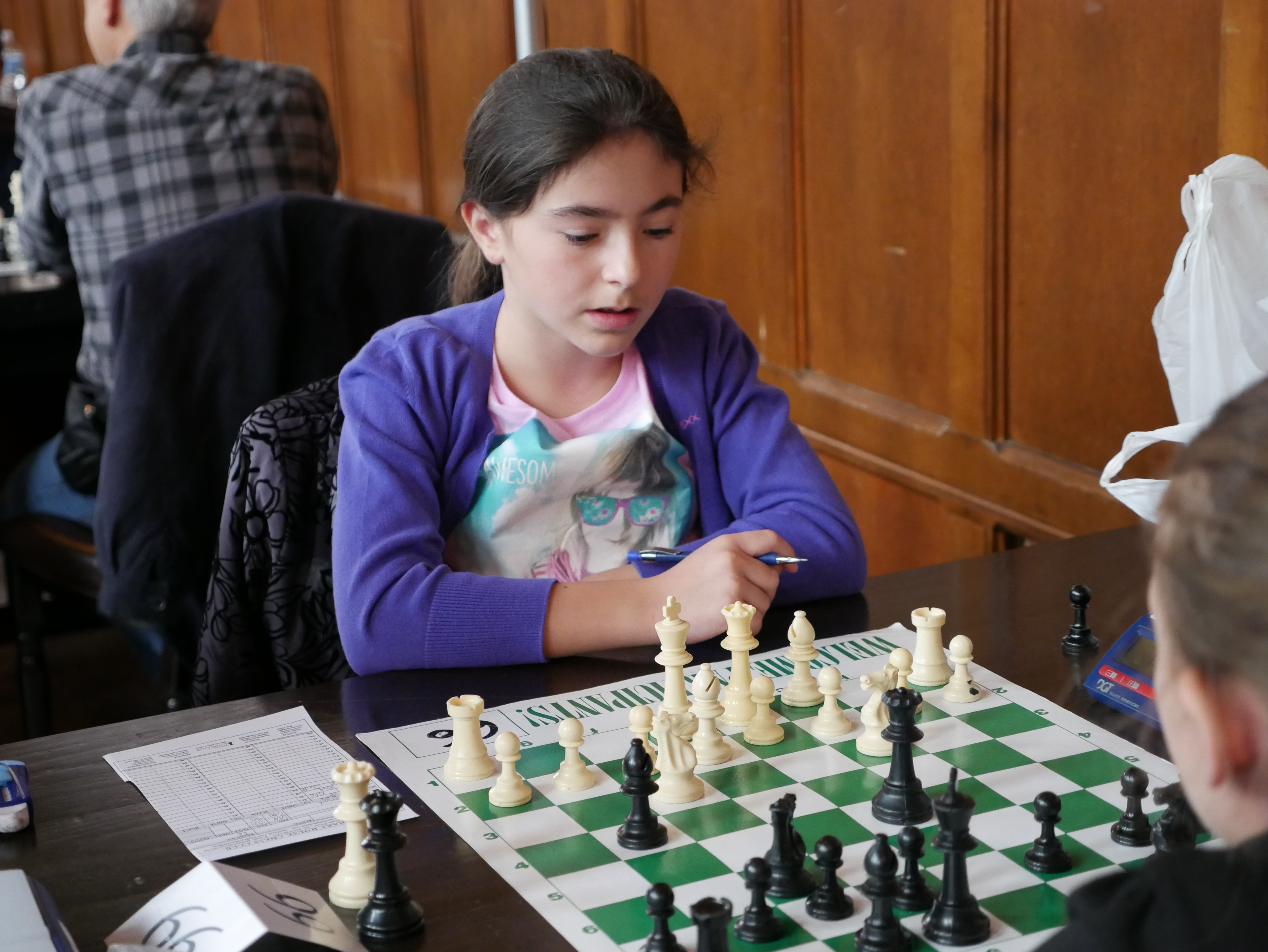
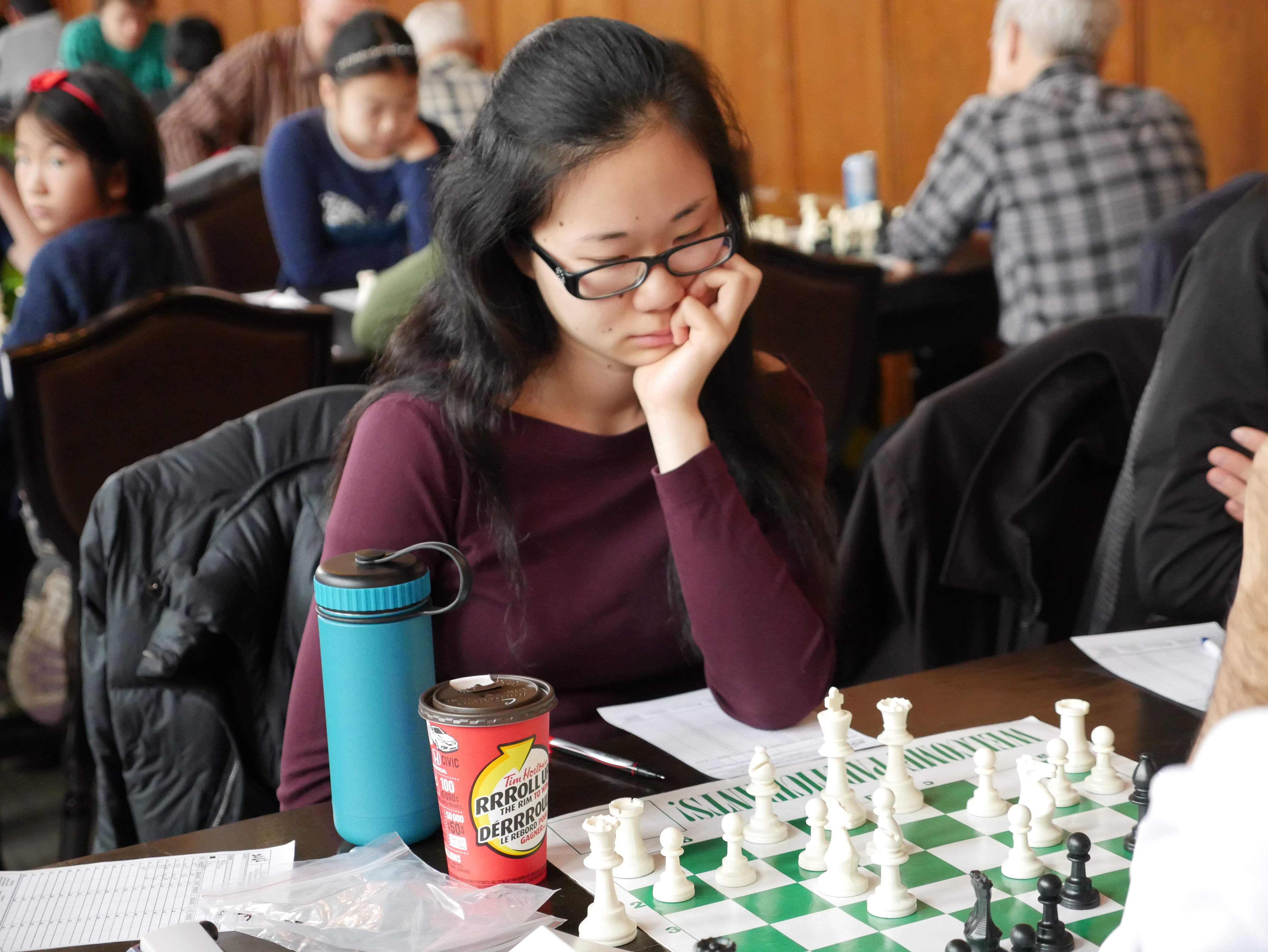


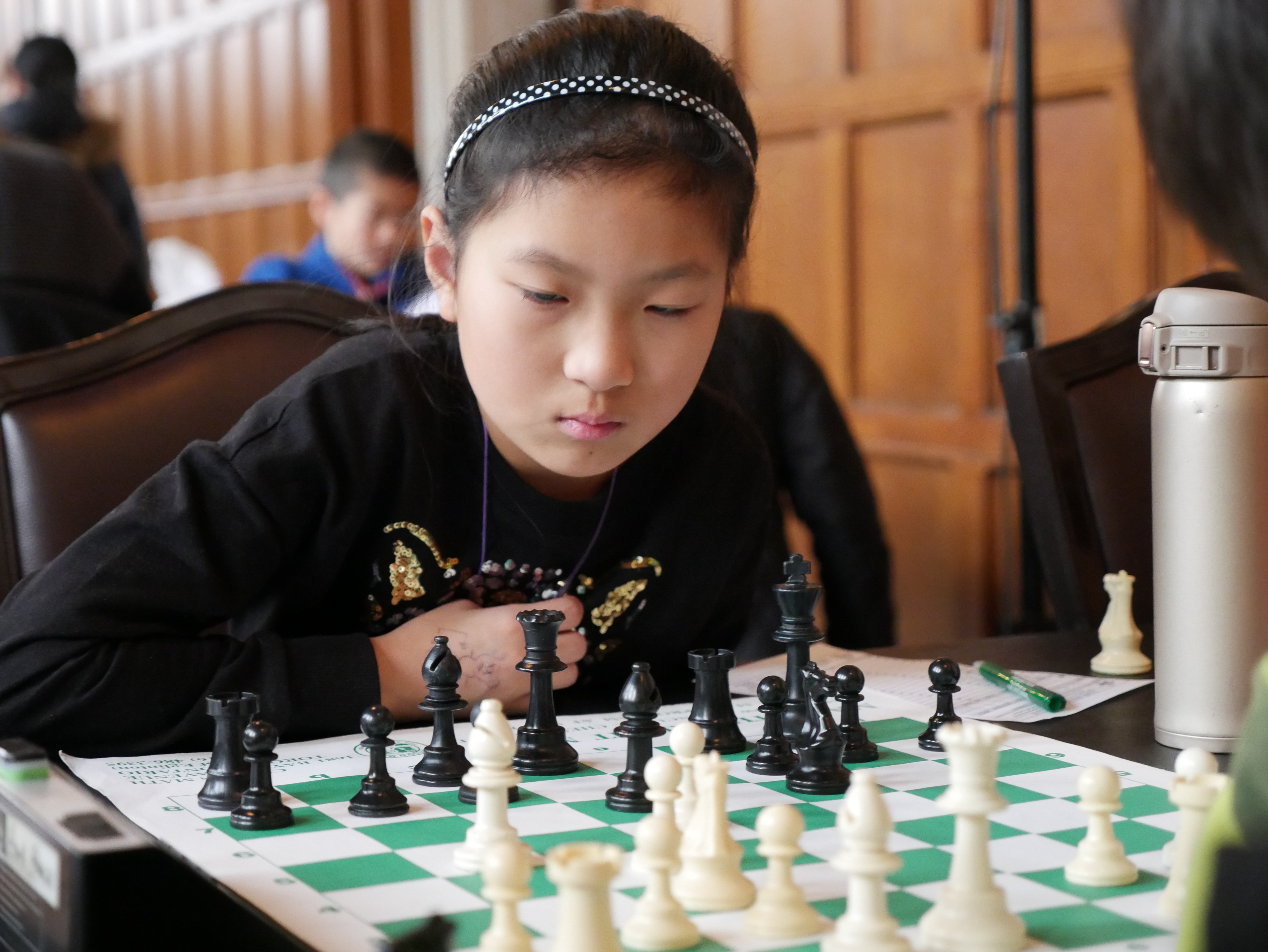


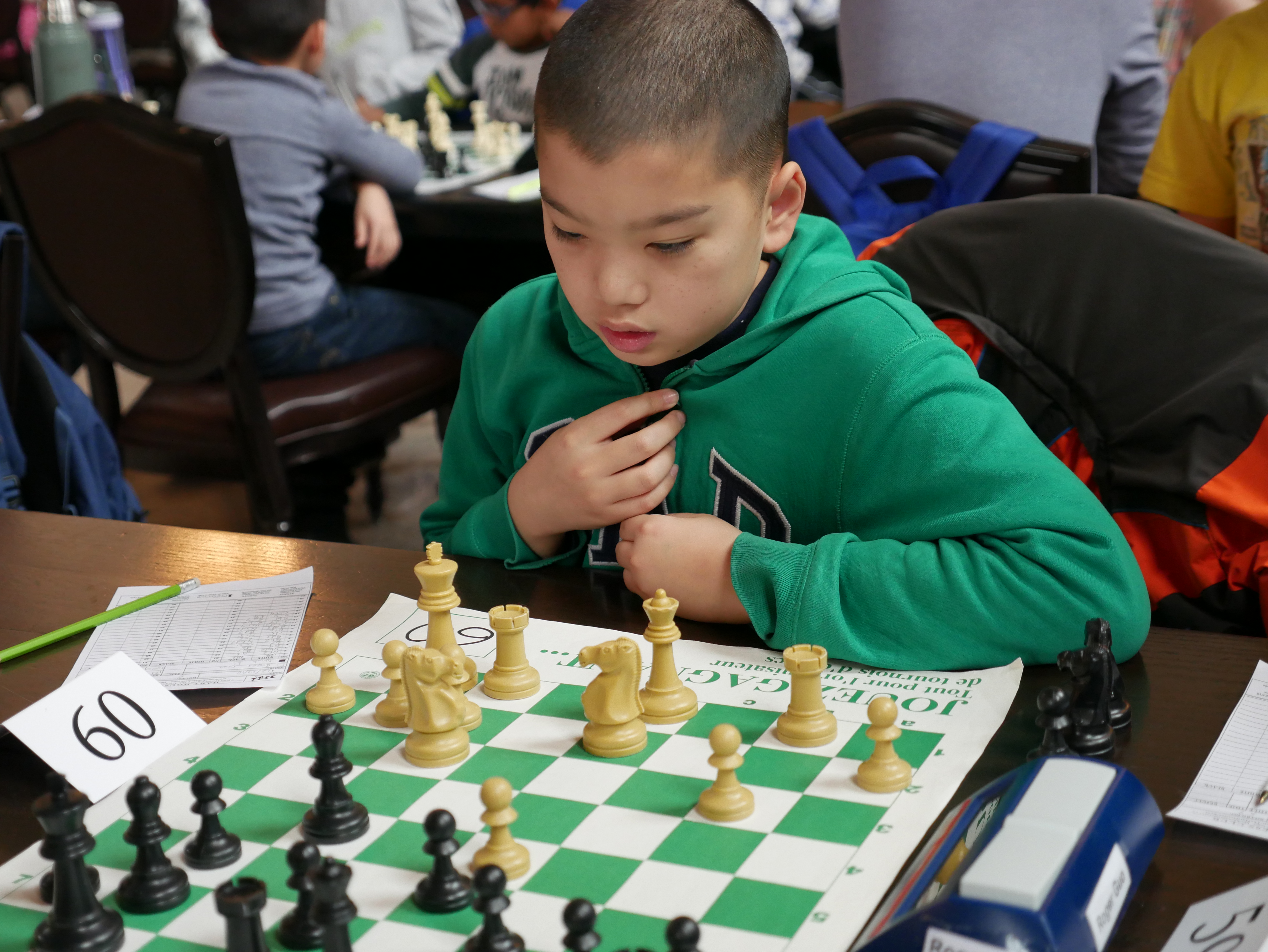
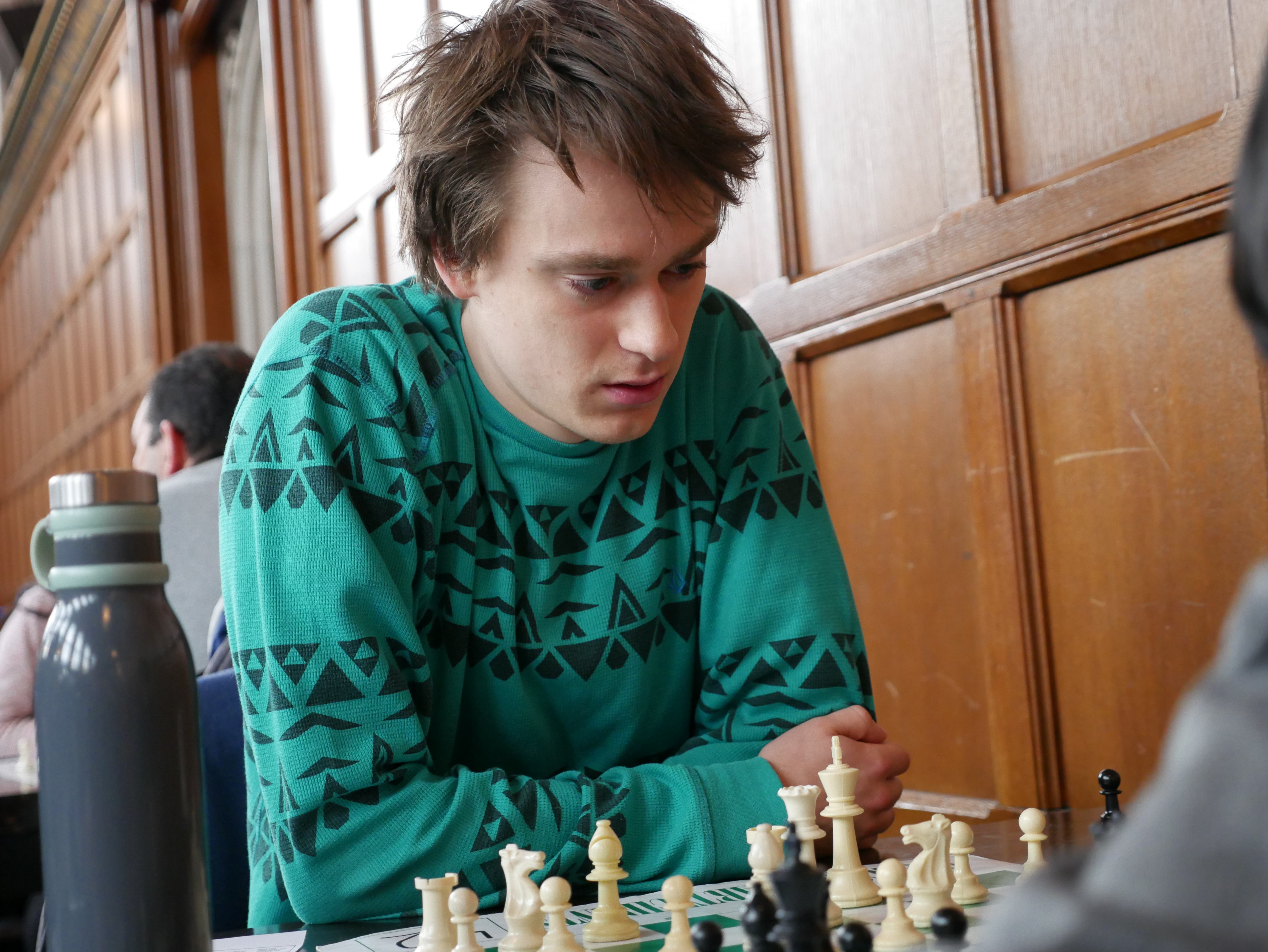


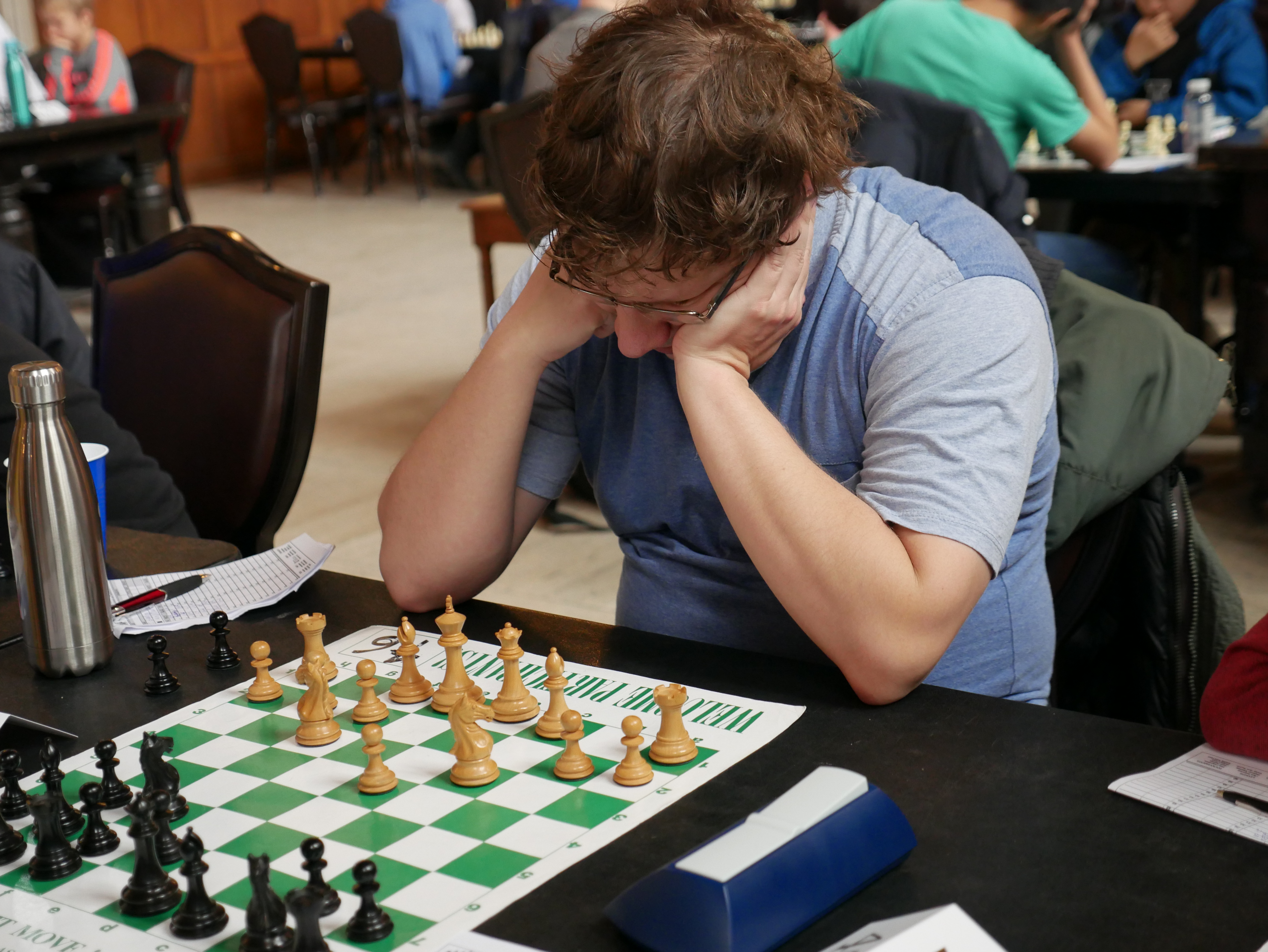

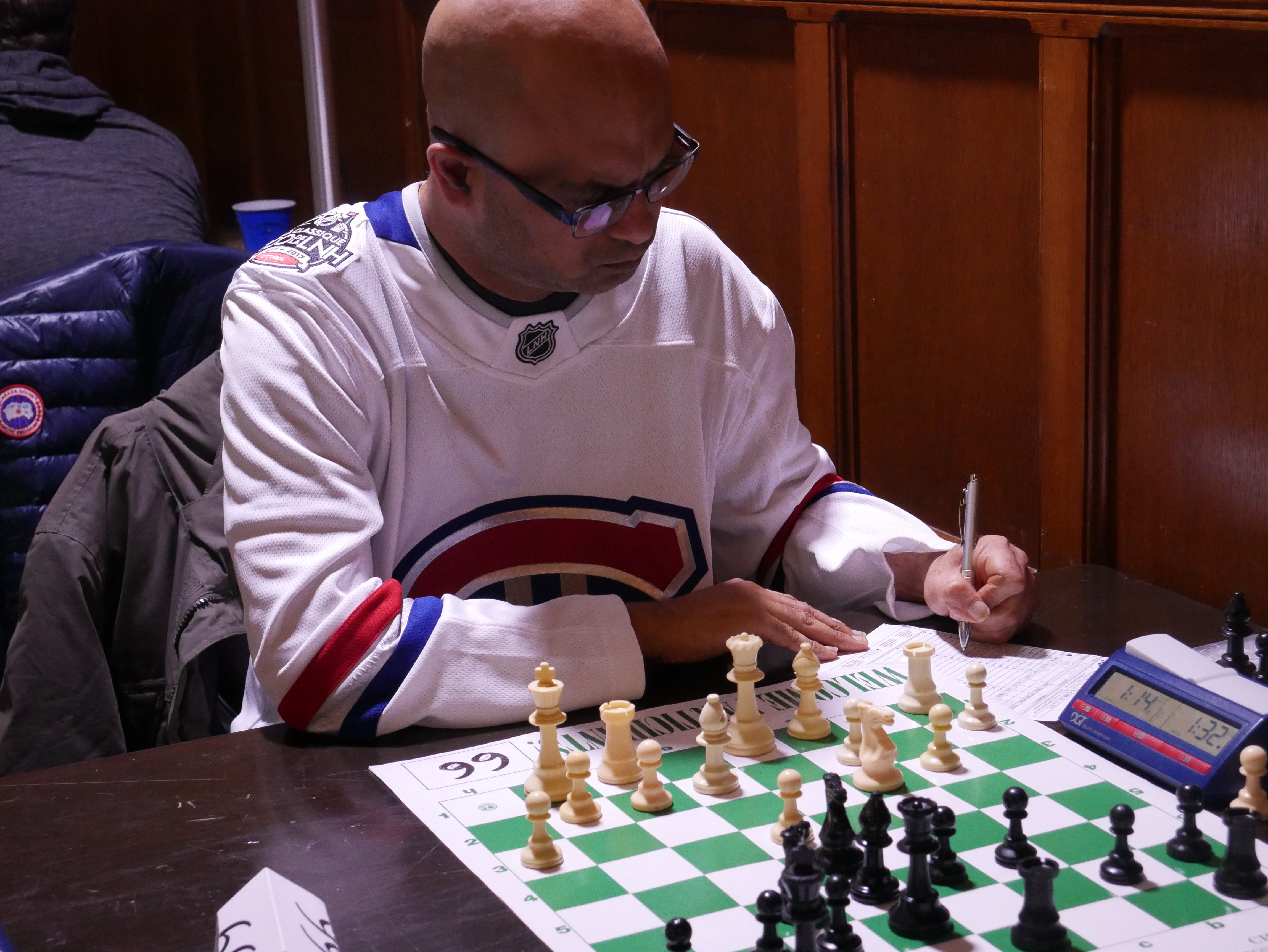


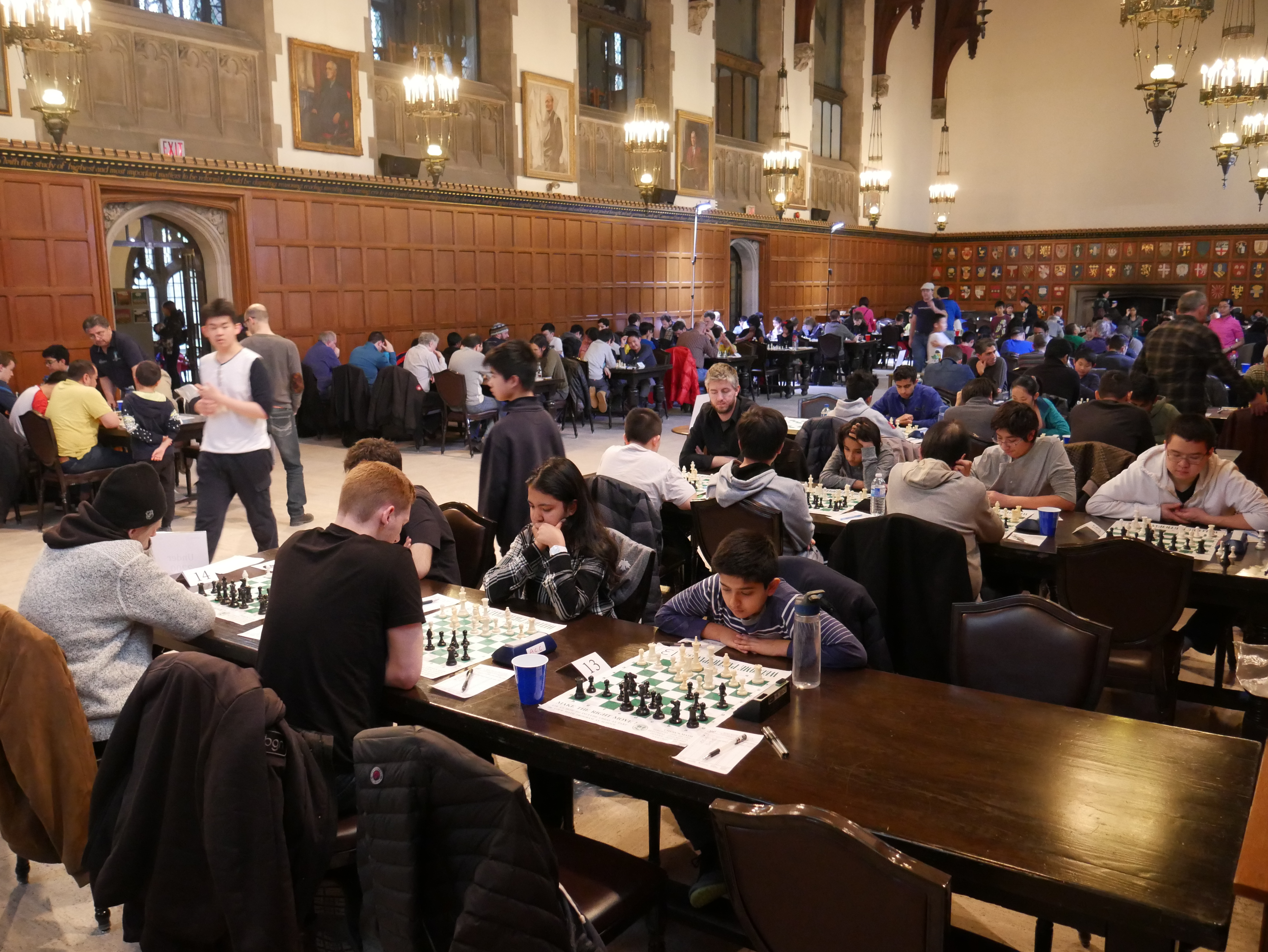


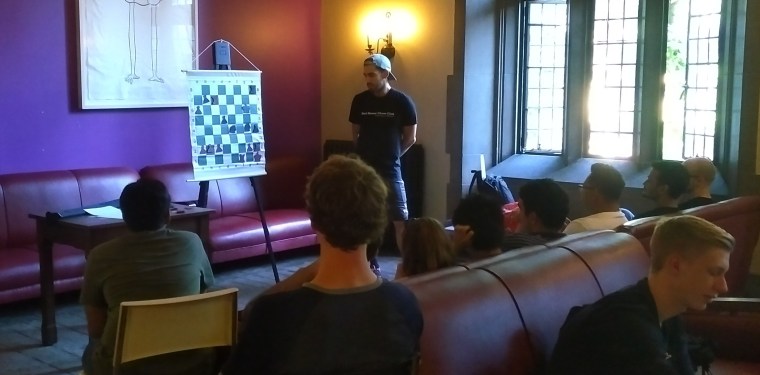 Starting on September 22nd and going until December 8th, Hart House Chess Club ran a 12-session workshop for beginner players who wanted to improve their game! The lessons were taught by our Varsity player Panayoti Tsialas and attracted a big number of passionate students!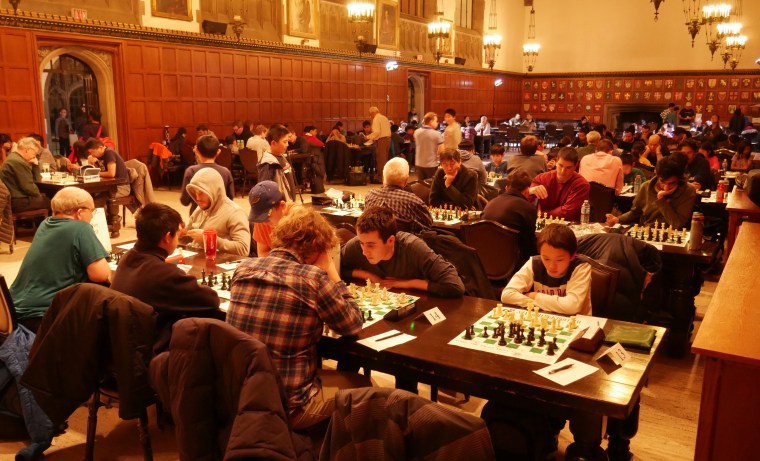

 Hart House Chess Club