Elly is a fourth-year student double majoring in Human Biology and Sociology. She strongly believes that the greater good of the society can only come from the dynamic interaction of people who strive to be better selves to better be themselves, much like chess players who strive to achieve self excellence and full potentials through constant game analysis and self improvement.
Other than her love for chess, HHCC being the unique organization within Hart House has made her feel safe, welcomed and supported. She wants to contribute back to HHCC as much as she can before graduation, and was inspired by last year’s execs, particularly the former president/secretary who made initiatives to include women in chess and encouraged her even more. She’s happy to serve on the committee as the president/secretary for this upcoming year, and she looks forward to learning from and growing with everyone within and outside HHCC.
Jennifer Xueyan Jiang is the Fundraising Representative at HHCC, who is in charge of hosting a series of events at HHCC including Fundraising Open Tournaments and kids’ favorite Junior Tournaments. She is flattered to work with other brilliant executives and the Fundraising Committee at HHCC. Jennifer is at the beginner level of chess and is deeply fascinated by a character in the TV show Person of Interest, who was teaching an artificial intelligence that ‘anyone who looks on the world as if it was a game of chess deserves to lose’.
Before her interest in chess, she became a second-dan player at Go, an ancient Asian board game. Jennifer also enjoys her academic life as a third-year international student at Rotman Commerce at UofT and wants to pursue a career in the accounting industry. Jennifer shows her great enthusiasm in reading economics magazines and watching suspense movies.
Sean Lei is a second-year Rotman student at the University of Toronto who is planning to major in accounting. He is an independent, free-willed, and strong spirit and is willing to do whatever it takes to get the job done. Beginning his chess career in 2012, he quickly climbed the rating ladder and achieved the National Master title in 2015. Since then, he’s taken a break from professional chess tournaments and has since then become a coach and instructor for various chess institutions around Toronto. Currently, he aspires to become a National Chess Arbiter in order to assist in the creation of chess tournaments that currently bring around so much joy to everyone who participate.
Sean is happy to serve as the 2019-2020 Hart House Chess Club treasurer and hopes to bring in his experiences and knowledge to the table and help bring out the best in everyone in the team.
Tanner is beginning his second year studying behavioural neuroscience at the Scarborough campus in the Psychology PhD program. He is focused on finding out what happens when we let rats drink alcohol, but he still finds time to enjoy chess. Tanner has played chess since the age of seven, after learning from his dad. Following mild success growing up in Maryland as a three-time state champion (Pre-Teen, Middle School, and High School), he went off to study at Carleton College. There he became President of the Chess Club and took a team to the Pan-American Intercollegiate Championship for the first time in school history in 2014. Despite earning awards for Biggest Team Upset and Top Small School, as well as an individual prize for Top Alternate, that team lost badly to a team from the University of Toronto.
Four years later, Tanner moved up north and switched sides, and now has represented the UofT at PanAms twice, as well as in other competitions, memorably at the World Prestigious University Invitational held in Tianjin, China in 2019. He is excited now to be starting his second consecutive term on the Executive Board serving as Events Coordinator. He is happy to give back to the Club that has treated him so well and to continue working with the game that has brought him so much joy over the years.
On Monday, June 24th, four teams from HHCC had a formidable showing at the 2019 Greater Toronto Chess League Cup. The GTCL Cup is an annual team tournament (with four players–or “boards”–per team) which brings together the vibrant Toronto chess community for a night of rapid games, fun banter, and spirited competition.
From alumni to new members, and from National Masters to players who’ve recently fallen in love with the game, HHCC sent a diverse and talented delegation to the tournament. Captained by Alex Ferreira (whose ingenuity and quick thinking allowed HHCC to create a fourth team just as the tournament was about to begin!), our teams performed exceptionally well.
Alex Ferreira, to whom HHCC owes a huge thank-you for setting up and captaining HHCC’s teams.
Despite not being able to play in the first round, Hart House Drafts placed fourth in the tournament with an outstanding 3.5/5 game points.
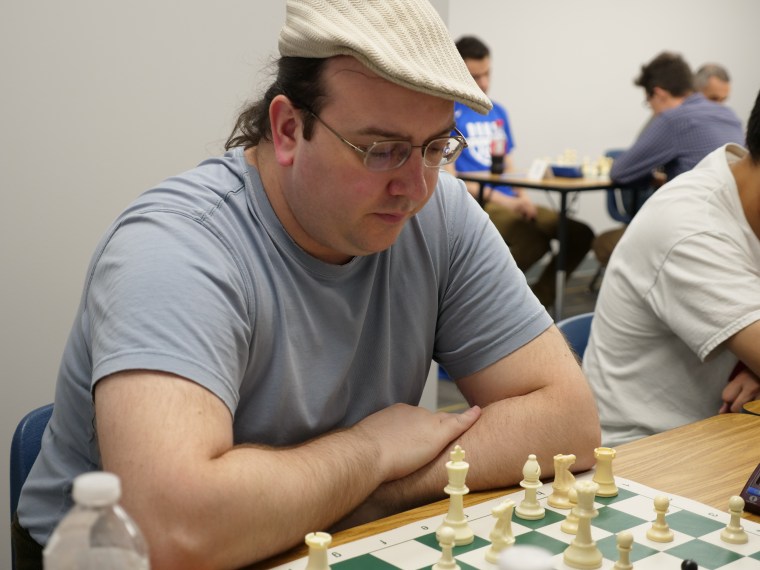
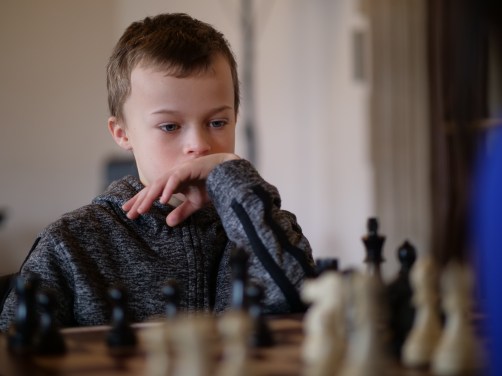
The Hart House Students team deeply engrossed in thought!
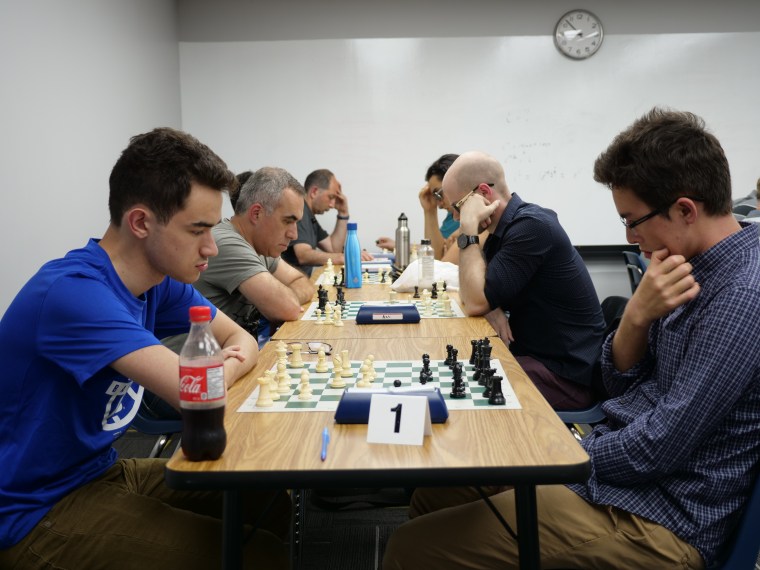
Hart House Masters accumulated a praiseworthy 3/5 and earned sixth place, and Hart House Students were but a half-point away.
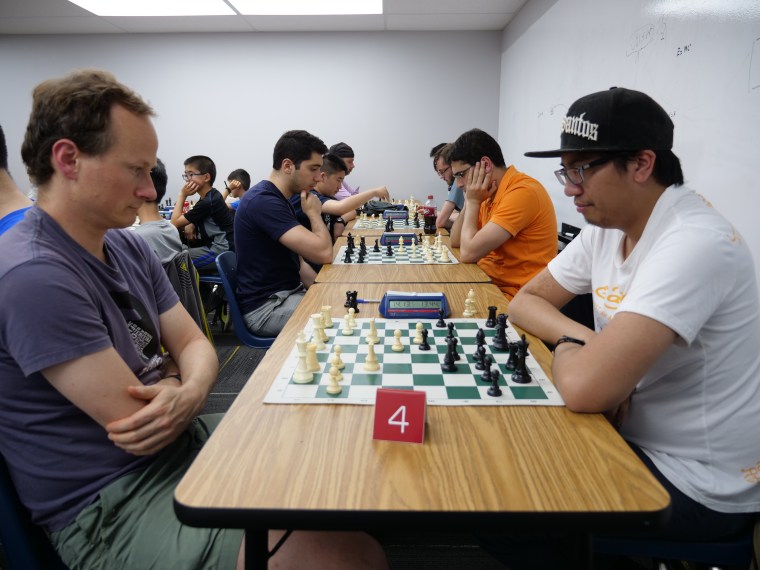
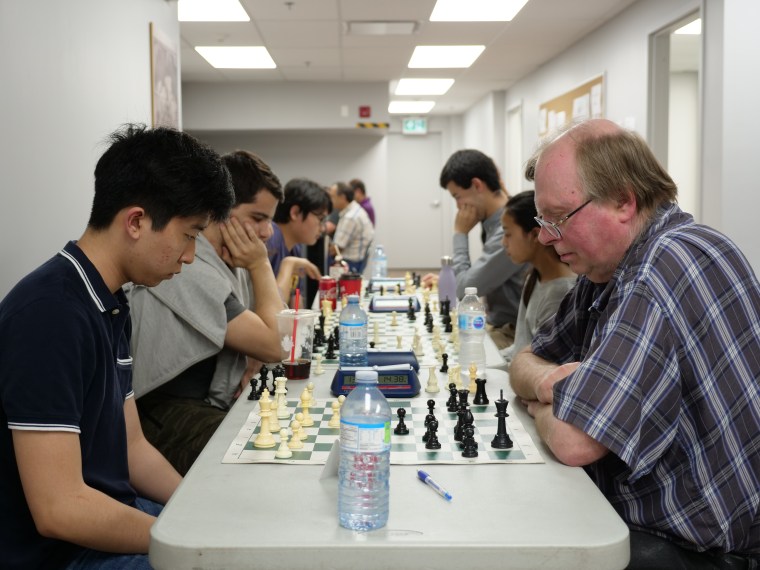
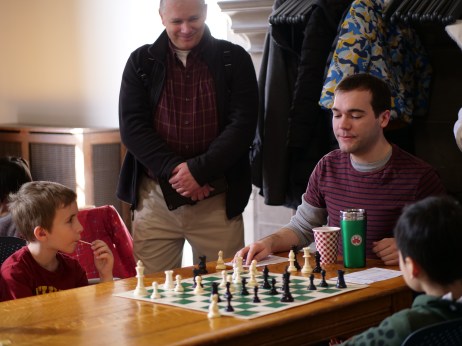
Hart House Masters (right) playing a match against Kids and Dads (left)
Hart House Blossoms–for some of whose players this was the very first tournament!–impressed us all with their dedication and resilience, earning an incredible 2 points.
Hart House Blossoms
Though, unlike last year, HHCC didn’t return with the grand trophy, the tournament was a wonderful experience. What a delight it was to witness the spirit of camaraderie among Hart House players from all walks of life!
We would like to take the chance to thank the organizers at Annex Chess Club for their time and unwavering commitment to putting together the fantastic tournament, and look forward very much to attending the GTCL Cup again next year!
A thank-you also goes to Panayoti Tsialas, Elly Chen and Alyssa Rusonik for compiling a photo-gallery of the event!
Hart House Chess Club hosted its Spring Junior Open tournament from March 16th to March 17th, 2019. It was the second junior chess event organized by our club in two consecutive years and what a blast it was! Held in the elegant Debates Room with the arched ceiling, the event attracted 22 young participants who showed everyone their confidence and chess skills during the March break.
Divided into two rating sections, an U- 900 and an U-1300 section, with 11 players each, the tournament offered 5 rounds of classical chess (55′ + 5”/move) in swiss-system. The competition was remarkably intense, as can be demonstrated by the ties for the top 3 in each section.
In the upper section especially, with one round to go, there was a long list of players from which the winner could have come out! Joshua Lau and Mark Rozin were leading with 3 out of 4 points but Yinan Wang, Ivan Huang and Zi Liu were a hair’s breath away from the top with 2.5 points in 4 games.
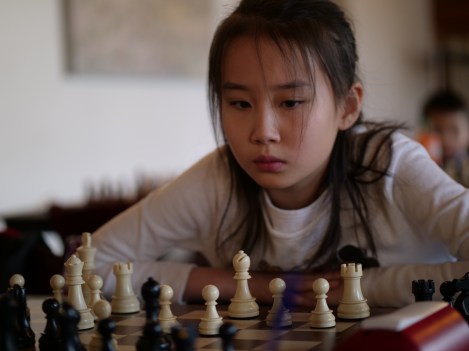
In the critical round-5 game, Zi Liu (white) faced Joshua Lau (black)!
In the last-round games, Ivan Huang managed to beat Mark Rozin, Zi Liu lost to Joshua Lau and Yinan Wang defeated Justin Huang.
This meant that Joshua Lau was sole first with 4/5, followed by Ivan Huang and Yinan Wang with 3.5/5 each. As the latter two had drawn their head-to-head game, the second tie-breaking criterion (opponent’s average rating) was decisive with Ivan Huang emerging on second place and the silver medal position! Lily Liu was also in a medal-winning position as she was the top girl in her section!
A light chuckle by Joshua Lau a few moments before winning the top place in the U-1300 section!
It’s also worth mentioning that the last round saw the best game of the U-1300, a spectacular victory by Sven Coat against Varun Pillai in the venomous Italian. After sacrificing two pawns Sven gained enough time in the opening to launch an unstoppable attack against his opponent’s king, checkmating him in the middle of the board.
Sven Coat did not manage to place among the top three this time but his spectacular last-round victory was jaw-dropping!
In the U-900 section things looked a bit clearer at the top level. Nora Wu entered the last round with 4 out of 4, threatened only by Karma Pillai and Yiming Zhao who had 3 out of 4 each. Gordon Zeng and Charis Zhu were also fighting for medals, with 2.5 points each.
After a double-edged game with opportunities for both sides, Nora Wu managed to win her game against Karma Pillai, scoring a perfect 5 out of 5 score and clinching the gold medal position! Charis Zhu and Gordon Zeng also won their games against Yiming Zhao and William Johnson, respectively, so they tied for second place with 3.5 points out of 5. Curiously enough, in a mirror image of the upper section, Charis and Gordon had drawn their head-to-head game so the second tie-breaking criterion had to be used, which placed Charis Zhu second and Gordon Zeng third. As for the top-female player distinction, the shiny medal was awarded to the very resilient Katelyn Johnson.
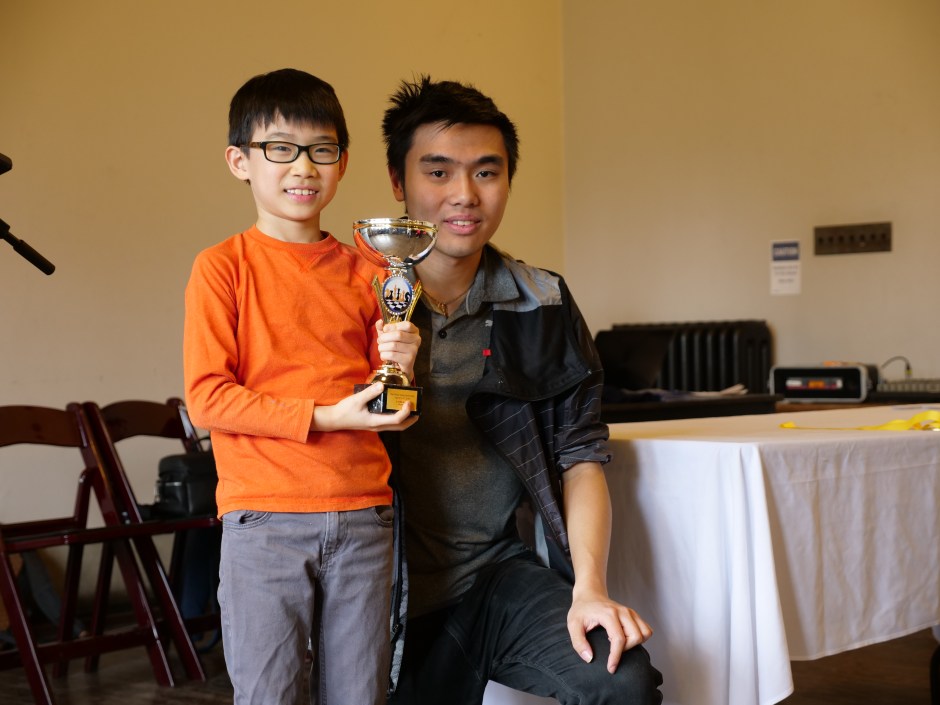
A formidable 5 out of 5 performance gave Nora Wu a very deserved first place!
As for the best game of the U-900 section, Jasper He and Charis Zhu must be very proud of their battle on Round 4. Their moves led to a slow and extremely positional game with opposite castles, where each side was fighting for the control of the center and the fast pawn expansion on the wing where the opposite king was. You don’t often see great strategic games like this between younger players.
Aided by the very good play of Jasper He, eight year-old Charis Zhu played the best game of the U-900 Section on Round 4.
The event organizers were delighted to introduce for the first time 11 beautiful digital boards in the competition, allowing the spectators to watch all the games live on-line! But March madness did not end with the live broadcasting of the games! With five national masters analyzing the games with the kids after each round, the excitement that swirled around the skittles room added even more to the enthusiasm of the day! A nice buffet of snacks and coffee was provided to the kids and the parents and a bulletin with the games of the tournament was sent out to all the participants for further review and analysis!
Alex Ferreira joined Weiwen Leung as one of the two tournament arbiters!
Of course, none of this could have happened without the very generous support of the UofT students, who volunteered a lot of their time and energy to boost the event. Weiwen Leung and Alex Ferreira were the event arbiters and did an excellent job running the pairings and providing the results, standings and tie-breaking criteria. The latter also took on the difficult task of the on-line registrations. Jimmy Bartha deserves some really high praise as he served as digital board operator in this first exciting trial! He was also the person who, with the aid of Sean Lei, Dmitry Choukov, Andrew MacMillan and Panayoti Tsialas, set-up the cables and the boards in the playing hall. Alyssa Rusonik, the incoming Communications Director of the club, was, once again, very efficient and exquisite in the handling of the on-site payments. Her ability to demonstrate leadership skills in every task she undertakes is outstanding.
National Master Tanner McNamara (here with William Johnson and Yiming Zhao) had a great time analyzing the kids’ games in the skittles room!
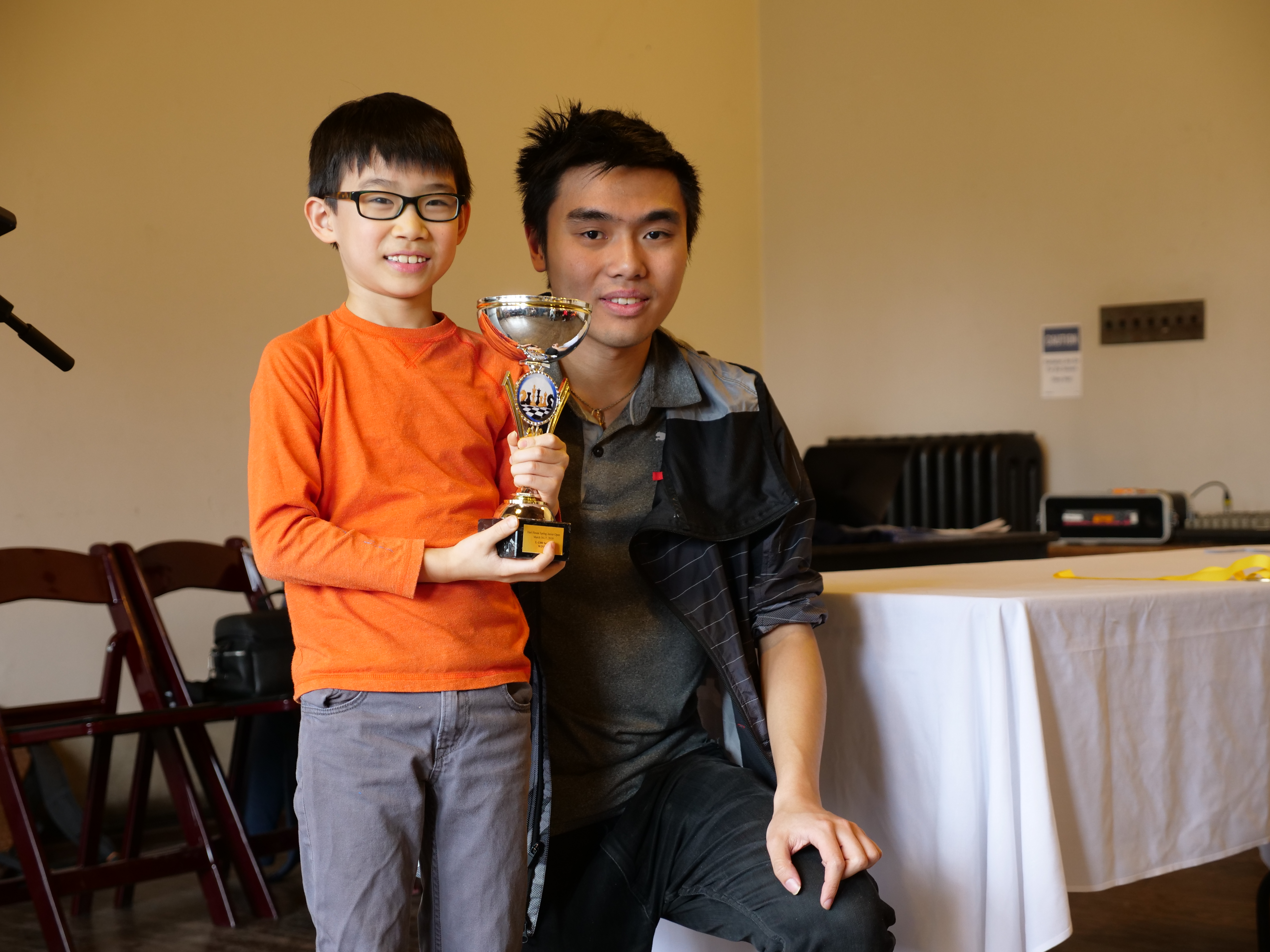
The club incurred a huge debt to Zara Toyserkani, who was at the skittles room from the very first till the very last minute of the tournament, taking care of the buffet and making sure that the parents and the kids would have a great time throughout their time at Hart House. Of course a big shout-out goes out to National Masters Sean Lei, Tanner McNamara, Jonathan Yu and Zane Nasir and to ex-Varsity player Gary Huang, who labored really hard in the skittles room, analyzing the games of the kids, providing helpful chess instruction and encouraging them to improve game by game! The combination UofT students analyzing chess games with the kids in the skittles room was and remains the most popular feature of our junior tournaments! The award ceremony was led by the very talented incoming club treasurer Sean Lei, who was delighted to congratulate the winners in each section! Finally, the tournament was directed by Panayoti Tsialas, whom the club would also like to thank for making the photo gallery and the bulletin of the games.
Snapping a pic of tournament director Panayoti Tsialas is not the easiest mission but Zara Toyserkani managed to get the shot!
It’s been a great pleasure for our club to organize its second Junior Tournament in two years. We are grateful to Hart House for providing us with all the assistance we need to run the event and, more than anyone else, we wish to thank all the participants and their parents for taking part in our tournament and supporting the official chess club of the students of UofT.
Jonathan Yu (CFC 2219)
Zane Nasir (CFC 2219)
Tanner McNamara (CFC 2121)
Gary Huang (CFC 1774)
Jimmy Bartha (CFC 1526)
Sahan Karunaratne (CFC 1495)
Alyssa Rusonik (CFC 1277)
Sunday, March 17th
Jonathan Yu (CFC 2219)
Sean Lei (CFC 2166)
Tanner McNamara (CFC 2121)
Panayoti Tsialas (CFC 2020)
Gary Huang (CFC 1774)
Jimmy Bartha (CFC 1526)
Sahan Karunaratne (CFC 1495)

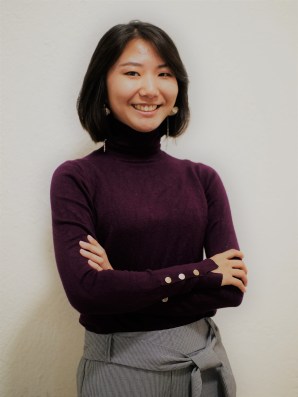 Elly is a fourth-year student double majoring in Human Biology and Sociology. She strongly believes that the greater good of the society can only come from the dynamic interaction of people who strive to be better selves to better be themselves, much like chess players who strive to achieve self excellence and full potentials through constant game analysis and self improvement.
 Sean Lei is a second-year Rotman student at the University of Toronto who is planning to major in accounting. He is an independent, free-willed, and strong spirit and is willing to do whatever it takes to get the job done. Beginning his chess career in 2012, he quickly climbed the rating ladder and achieved the National Master title in 2015. Since then, he’s taken a break from professional chess tournaments and has since then become a coach and instructor for various chess institutions around Toronto. Currently, he aspires to become a National Chess Arbiter in order to assist in the creation of chess tournaments that currently bring around so much joy to everyone who participate.
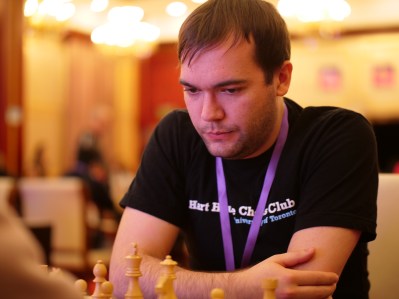 Tanner is beginning his second year studying behavioural neuroscience at the Scarborough campus in the Psychology PhD program. He is focused on finding out what happens when we let rats drink alcohol, but he still finds time to enjoy chess. Tanner has played chess since the age of seven, after learning from his dad. Following mild success growing up in Maryland as a three-time state champion (Pre-Teen, Middle School, and High School), he went off to study at Carleton College. There he became President of the Chess Club and took a team to the Pan-American Intercollegiate Championship for the first time in school history in 2014. Despite earning awards for Biggest Team Upset and Top Small School, as well as an individual prize for Top Alternate, that team lost badly to a team from the University of Toronto.